Ch. 5 - Chemical Reaction Analysis: Thermodynamics and Kinetics
Mullins - Organic Chemistry: A Learner Centered Approach 1st Edition
Mullins1st EditionOrganic Chemistry: A Learner Centered ApproachISBN: 9780137566471Non è quello che usi tu?Cambia libro di testo
Capitolo 4, Problema 26a

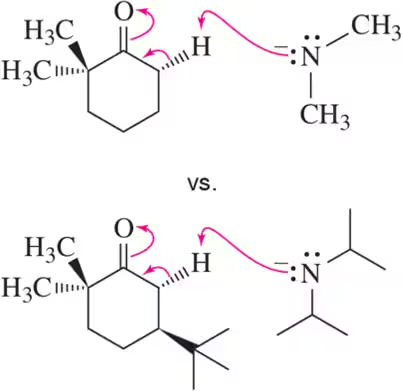
Within the following pairs, pick which reaction you would expect to be faster based on having a higher value of the frequency factor (A).
(a) Chemical reaction energy diagrams comparing two reactions with different frequency factors, highlighting reaction pathways and intermediates.

Guida verificata passo dopo passo
1
Understand the concept of the frequency factor (A): The frequency factor is a component of the Arrhenius equation, which describes the rate constant (k) of a reaction. The equation is: k = A e-ERT. Here, A represents the frequency of collisions with the correct orientation for a reaction to occur.
Analyze the factors affecting the frequency factor (A): A depends on the molecular structure, size, and complexity of the reactants. Simpler molecules with fewer steric hindrances and more favorable orientations for collisions typically have higher values of A.
Compare the molecular structures of the reactants in the given pairs: Examine the size, complexity, and steric hindrance of the molecules in each pair. Simpler and less hindered molecules are expected to have a higher frequency factor.
Consider the reaction mechanism: If one reaction involves a simpler mechanism (e.g., fewer steps or less steric hindrance in the transition state), it is likely to have a higher frequency factor.
Select the faster reaction based on A: Based on the analysis of molecular structure and reaction mechanism, identify which reaction in the pair is expected to have a higher frequency factor and thus proceed faster.

Risposta video verificata per un problema simile:

Questa soluzione video è stata consigliata dai nostri tutor come utile per risolvere questo problema.
Durata del video:
6m

Concetti chiave

Ecco i concetti essenziali che devi comprendere per rispondere correttamente alla domanda.

Frequency Factor (A)

The frequency factor, often denoted as A in the Arrhenius equation, represents the frequency of collisions between reactant molecules that can lead to a reaction. A higher frequency factor indicates that the reactants are more likely to collide in the correct orientation and with sufficient energy to overcome the activation energy barrier, thus increasing the reaction rate.
Video consigliato:
16:47
Common IR Frequencies

Activation Energy (Ea)

Activation energy is the minimum energy required for a chemical reaction to occur. It is a crucial factor in determining the rate of a reaction; reactions with lower activation energies tend to proceed faster because a greater proportion of the reactant molecules have enough energy to overcome this barrier during collisions.
Video consigliato:
Percorso guidato
3:22
EAS Reactions of Pyridine Concept 3

Reaction Mechanism

A reaction mechanism is a step-by-step description of the pathway taken by reactants to form products. Understanding the mechanism helps in predicting which reactions will be faster, as it provides insight into the number of elementary steps involved and the energy changes associated with each step, influencing both the frequency factor and activation energy.
Video consigliato:
02:16
Heck Reaction Mechanism