Ch. 6 - Stereoisomerism: Arrangement of Atoms in Space
Mullins - Organic Chemistry: A Learner Centered Approach 1st Edition
Mullins1st EditionOrganic Chemistry: A Learner Centered ApproachISBN: 9780137566471Non è quello che usi tu?Cambia libro di testo
Capitolo 5, Problema 5d

What type of isomerism is indicated by each of the following pairs of molecules? Be as specific as possible.
(d)

Guida verificata passo dopo passo
1
Step 1: Analyze the molecular structures provided in the image. The first molecule has a hydroxyl (-OH) group attached to the second carbon in a three-carbon chain (isopropanol), while the second molecule has the hydroxyl group attached to the first carbon in a three-carbon chain (1-propanol).
Step 2: Recognize that both molecules have the same molecular formula, C3H8O, indicating they are isomers.
Step 3: Determine the type of isomerism. Since the difference lies in the position of the functional group (-OH) on the carbon chain, this is an example of positional isomerism.
Step 4: Positional isomerism occurs when the functional group is attached to different positions on the same carbon skeleton, while maintaining the same molecular formula.
Step 5: Conclude that the pair of molecules in the image exhibit positional isomerism due to the differing locations of the hydroxyl group on the carbon chain.

Risposta video verificata per un problema simile:

Questa soluzione video è stata consigliata dai nostri tutor come utile per risolvere questo problema.

Concetti chiave

Ecco i concetti essenziali che devi comprendere per rispondere correttamente alla domanda.

Isomerism

Isomerism refers to the phenomenon where two or more compounds have the same molecular formula but differ in the arrangement of atoms. This can lead to distinct physical and chemical properties. Isomers can be classified into structural isomers, which differ in the connectivity of atoms, and stereoisomers, which have the same connectivity but differ in the spatial arrangement of atoms.
Video consigliato:
06:47
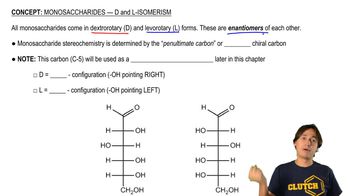
Monosaccharides - D and L Isomerism

Structural Isomerism

Structural isomerism occurs when isomers differ in the connectivity of their atoms. This can include variations such as chain isomerism, where the carbon skeleton differs, and functional group isomerism, where the isomers contain different functional groups. Understanding structural isomerism is crucial for predicting the reactivity and properties of organic compounds.
Video consigliato:
06:47
Monosaccharides - D and L Isomerism

Stereoisomerism

Stereoisomerism is a type of isomerism where isomers have the same molecular formula and connectivity but differ in the three-dimensional arrangement of atoms. This includes geometric isomerism (cis-trans isomerism) and optical isomerism (enantiomers). Stereoisomers can exhibit different behaviors in biological systems, making this concept essential for understanding molecular interactions.
Video consigliato:
01:58
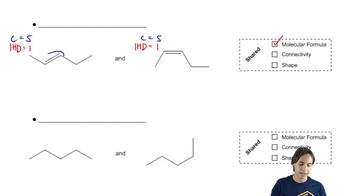
Determining when molecules are stereoisomers.