Ch. 8 - Alkenes 1: Properties and Electrophilic Additions
Mullins - Organic Chemistry: A Learner Centered Approach 1st Edition
Mullins1st EditionOrganic Chemistry: A Learner Centered ApproachISBN: 9780137566471Non è quello che usi tu?Cambia libro di testo
Capitolo 7, Problema 67

Because of the angle strain present in cyclopropanes, they tend to open up in the presence of nearby radicals. Show a mechanism for the following reaction that demonstrates this principle.

Guida verificata passo dopo passo
1
Begin by recognizing that the cyclopropane ring is highly strained due to its small bond angles. This strain makes it susceptible to ring-opening reactions, especially in the presence of radicals.
The presence of HBr and H2O2 suggests a radical mechanism. H2O2 can decompose to form hydroxyl radicals, which can initiate the radical chain reaction.
The hydroxyl radical abstracts a hydrogen atom from HBr, generating a bromine radical. This bromine radical is crucial for the next step of the mechanism.
The bromine radical attacks the cyclopropane ring, leading to the opening of the ring. This attack results in the formation of a new radical at the site where the ring opens.
The newly formed radical can then react with another molecule of HBr, abstracting a hydrogen atom and forming the final product with a bromine atom attached to the terminal carbon of the opened chain.

Risposta video verificata per un problema simile:

Questa soluzione video è stata consigliata dai nostri tutor come utile per risolvere questo problema.
Durata del video:
9m

Concetti chiave

Ecco i concetti essenziali che devi comprendere per rispondere correttamente alla domanda.

Angle Strain

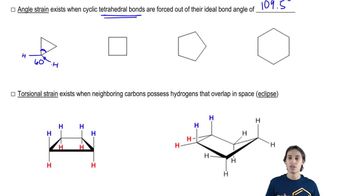
Angle strain occurs when the bond angles in a molecule deviate from the ideal values, causing increased energy and instability. In cyclopropanes, the bond angles are approximately 60 degrees, which is significantly less than the ideal tetrahedral angle of 109.5 degrees. This strain makes cyclopropanes more reactive, particularly in the presence of radicals, as they seek to relieve this strain by breaking bonds.
Video consigliato:
02:46
What is angle strain?

Radical Mechanism

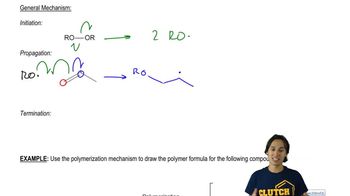
A radical mechanism involves the formation and reaction of species with unpaired electrons, known as radicals. These highly reactive intermediates can initiate chain reactions, such as the opening of strained rings like cyclopropanes. Understanding how radicals interact with cyclopropanes is crucial for illustrating the mechanism of the reaction, as they can lead to the cleavage of C-C bonds and the formation of new products.
Video consigliato:
03:28
The mechanism of Radical Polymerization.

Reaction Mechanism

A reaction mechanism is a step-by-step description of the process by which reactants transform into products. It outlines the sequence of bond-breaking and bond-forming events, including the involvement of intermediates like radicals. In the case of cyclopropanes, illustrating the mechanism helps to clarify how the angle strain facilitates the reaction and the specific steps taken during the bond cleavage and formation.
Video consigliato:
02:16
Heck Reaction Mechanism