

Ch. 8 - Alkenes 1: Properties and Electrophilic Additions
Mullins - Organic Chemistry: A Learner Centered Approach 1st Edition
Mullins1st EditionOrganic Chemistry: A Learner Centered ApproachISBN: 9780137566471Non è quello che usi tu?Cambia libro di testo
Capitolo 7, Problema 71c

Predict the product of each of the following hydroboration–oxidation or oxymercuration–reduction reactions used in the modern synthetic organic chemistry literature (modified to use reagents we are used to seeing).
(c) A similar sequence was featured in the synthesis of muricadienin, a proposed precursor in the biosynthesis of solamin (Org. Lett. 2014, 16, 5886–5889).

Guida verificata passo dopo passo
1
Step 1: Recognize the reaction type. This is a hydroboration–oxidation reaction, which involves the addition of water across a double bond in an anti-Markovnikov fashion. The reagents used are BH₃ (borane) followed by NaOH and H₂O₂ (hydrogen peroxide).
Step 2: Identify the alkene in the molecule. The structure contains a terminal alkyne and a conjugated diene. Focus on the terminal alkyne, as hydroboration–oxidation typically targets the triple bond in this case.
Step 3: Predict the regioselectivity. Hydroboration–oxidation adds water across the triple bond in an anti-Markovnikov fashion, meaning the hydroxyl group (-OH) will attach to the less substituted carbon of the alkyne.
Step 4: Consider the stereochemistry. Hydroboration–oxidation of alkynes typically results in the formation of an enol intermediate, which tautomerizes to a ketone. The final product will be a ketone at the terminal carbon.
Step 5: Draw the product. The terminal alkyne will be converted into a ketone, while the rest of the molecule remains unchanged. Ensure that no other functional groups are affected by the reaction conditions.

Risposta video verificata per un problema simile:

Questa soluzione video è stata consigliata dai nostri tutor come utile per risolvere questo problema.
Durata del video:
5m

Concetti chiave

Ecco i concetti essenziali che devi comprendere per rispondere correttamente alla domanda.

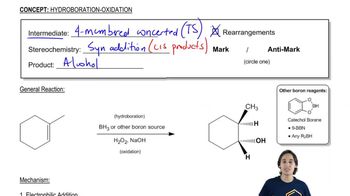
Hydroboration-Oxidation

Hydroboration-oxidation is a two-step reaction that converts alkenes into alcohols. In the first step, borane (BH3) adds across the double bond of the alkene, forming an organoborane intermediate. This is followed by oxidation with hydrogen peroxide (H2O2) in the presence of a base, which replaces the boron atom with a hydroxyl group, yielding an alcohol. This reaction is notable for its anti-Markovnikov selectivity.
Video consigliato:
06:38
General properties of hydroboration-oxidation.

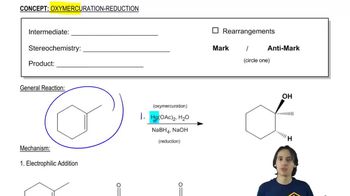
Oxymercuration-Reduction

Oxymercuration-reduction is another method for converting alkenes to alcohols. It involves the addition of mercuric acetate (Hg(OAc)2) to the alkene, forming a mercurinium ion intermediate. Water then attacks this intermediate, leading to the formation of an alcohol after reduction with sodium borohydride (NaBH4). This reaction also follows Markovnikov's rule, providing a way to selectively add functional groups to alkenes.
Video consigliato:
05:
General properties of oxymercuration-reduction.

Stereochemistry of Reactions

Understanding the stereochemistry of hydroboration-oxidation and oxymercuration-reduction is crucial for predicting the products of these reactions. Hydroboration leads to syn-addition, where both substituents add to the same side of the double bond, while oxymercuration typically results in anti-addition. This difference in stereochemistry can affect the final product's configuration, which is important in synthetic organic chemistry, especially when synthesizing complex molecules.
Video consigliato:
Percorso guidato
1:38
Polymer Stereochemistry Concept 1
Pratica correlata
Domanda del libro di testo

In light of your answer to Assessment 8.73, predict the product of the following oxymercuration–reduction reactions, each of which results in a single product. [Don't worry about the absolute stereochemistry, though these reactions are also stereoselective.]

(b) This reaction sequence was used in the synthesis of (+) -lineatin, a monoterpene aggregation pheromone from the female ambrosia beetle Trypodendron lineatum (Org. Lett. 2004, 6, 1449–1452).

413
views
Domanda del libro di testo

In light of your answer to Assessment 8.73, predict the product of the following oxymercuration–reduction reactions, each of which results in a single product. [Don't worry about the absolute stereochemistry, though these reactions are also stereoselective.]

(c) Oxymercuration–reduction was used in the stereoselective synthesis of the macrolactone core of neopeltolide, a marine macrolide isolated from a Caribbean sponge that has potent anticancer activity (Org. Lett. 2012, 14, 2346–2349).

626
views
Domanda del libro di testo

Predict the product of each of the following hydroboration–oxidation or oxymercuration–reduction reactions used in the modern synthetic organic chemistry literature (modified to use reagents we are used to seeing).

(b) A two-step hydroboration–oxidation was used to prepare a silanediol peptidomimetic as a serine protease inhibitor (Org. Lett. 2012, 14, 4422–4425).

1022
views
Domanda del libro di testo

A common situation occurs when both carbons of the mercurinium ion are secondary. In a situation like the one shown, to which carbon would you expect water to add? That is, would you expect to produce A or B? Explain your answer.

1119
views
Domanda del libro di testo

When using sulfuric acid, but in the absence of other nucleophiles like water or bromide ion, less stable alkenes can be isomerized to their more stable isomer. Provide a mechanism for these acid-catalyzed isomerization reactions. [This is one illustration of the principle of microscopic reversibility.]

(c)

106
views
Domanda del libro di testo

If you react carvone with a single equivalent of HBr, only one product is produced, even though carvone has two carbon–carbon double bonds. Explain this observation.

1488
views