Ch. 8 - Alkenes 1: Properties and Electrophilic Additions
Mullins - Organic Chemistry: A Learner Centered Approach 1st Edition
Mullins1st EditionOrganic Chemistry: A Learner Centered ApproachISBN: 9780137566471Non è quello che usi tu?Cambia libro di testo
Capitolo 7, Problema 46a

Provide a mechanism for the following reactions occurring with rearrangement.
(a)

Guida verificata passo dopo passo
1
Step 1: Protonation of the alkene - The reaction begins with the alkene reacting with the sulfuric acid (H₂SO₄). The π-electrons of the double bond attack the proton (H⁺) from H₂SO₄, leading to the formation of a carbocation. This step generates a secondary carbocation at the more stable position due to Markovnikov's rule.
Step 2: Carbocation rearrangement - The initially formed secondary carbocation undergoes a hydride shift (rearrangement) to form a more stable tertiary carbocation. This occurs because tertiary carbocations are more stable than secondary carbocations due to hyperconjugation and inductive effects.
Step 3: Nucleophilic attack by water - Water (H₂O) acts as a nucleophile and attacks the positively charged carbon of the tertiary carbocation, forming an oxonium ion (a positively charged oxygen species).
Step 4: Deprotonation - The oxonium ion loses a proton (H⁺) to form the final alcohol product. This step is facilitated by the surrounding water molecules acting as a base.
Step 5: Final product - The reaction yields the rearranged alcohol product, where the hydroxyl group (-OH) is attached to the carbon that was part of the tertiary carbocation.

Concetti chiave

Ecco i concetti essenziali che devi comprendere per rispondere correttamente alla domanda.

Reaction Mechanisms

A reaction mechanism is a step-by-step description of how a chemical reaction occurs at the molecular level. It outlines the sequence of elementary steps, including bond breaking and forming, and the intermediates involved. Understanding mechanisms is crucial for predicting the products of reactions and the conditions under which they occur.
Video consigliato:
02:16
Heck Reaction Mechanism

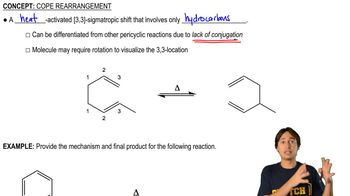
Rearrangement Reactions

Rearrangement reactions involve the structural reorganization of a molecule to form a different isomer. These reactions often occur through the migration of atoms or groups within the molecule, leading to more stable configurations. Recognizing the types of rearrangements, such as hydride shifts or alkyl shifts, is essential for predicting the outcome of the reaction.
Video consigliato:
06:28
Definition of Cope Rearrangement

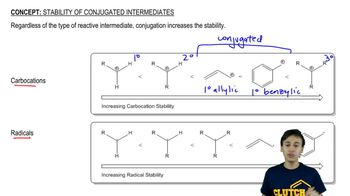
Stability of Intermediates

The stability of intermediates plays a critical role in determining the pathway of a reaction. Intermediates, such as carbocations or carbanions, can significantly influence the rate and outcome of a reaction. Understanding factors that affect their stability, such as resonance and inductive effects, helps in predicting the favored reaction mechanism and products.
Video consigliato:
04:31
Stability of Conjugated Intermediates