Ch. 8 - Alkenes 1: Properties and Electrophilic Additions
Mullins - Organic Chemistry: A Learner Centered Approach 1st Edition
Mullins1st EditionOrganic Chemistry: A Learner Centered ApproachISBN: 9780137566471Non è quello che usi tu?Cambia libro di testo
Capitolo 7, Problema 8.39d

Provide the expected product for the reaction of each of the following alkenes with H₂SO₄ and H₂O.


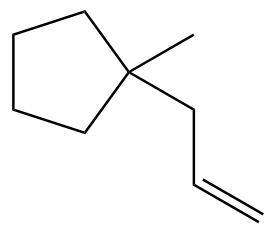
(d) Chemical structure of an alkene for acid-catalyzed hydration in organic chemistry.

Guida verificata passo dopo passo
1
Identify the alkene in the given structure. The double bond is located at the end of the carbon chain attached to the cyclopentane ring.
Understand that the reaction involves the addition of H₂SO₄ (sulfuric acid) and H₂O (water), which is an acid-catalyzed hydration reaction.
Recognize that the mechanism follows Markovnikov's rule, where the hydrogen atom (H⁺) from H₂SO₄ will add to the carbon with the most hydrogen atoms already attached, and the hydroxyl group (OH⁻) will add to the other carbon of the double bond.
Determine the more stable carbocation intermediate that forms during the reaction. In this case, the carbocation will form on the carbon adjacent to the cyclopentane ring, as it will be more stable due to hyperconjugation and inductive effects.
Add the OH group to the carbon that forms the more stable carbocation, resulting in the final product where the double bond is replaced by a single bond, and an OH group is attached to the carbon adjacent to the cyclopentane ring.

Risposta video verificata per un problema simile:

Questa soluzione video è stata consigliata dai nostri tutor come utile per risolvere questo problema.
Durata del video:
3m

Concetti chiave

Ecco i concetti essenziali che devi comprendere per rispondere correttamente alla domanda.

Electrophilic Addition

Electrophilic addition is a fundamental reaction mechanism in organic chemistry where an electrophile reacts with a nucleophile, typically involving alkenes. In the case of alkenes reacting with H₂SO₄, the double bond acts as a nucleophile, attacking the electrophilic sulfur atom, leading to the formation of a carbocation intermediate.
Video consigliato:
09:23
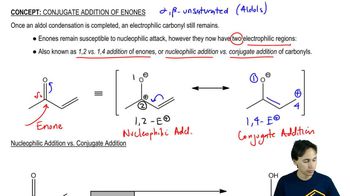
1,2 vs 1,4 Addition

Carbocation Stability

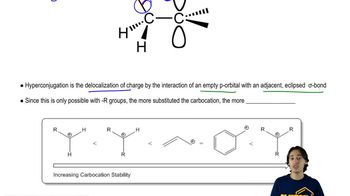
Carbocation stability is crucial in determining the outcome of reactions involving alkenes. More stable carbocations, such as tertiary carbocations, are favored over less stable ones. The stability is influenced by factors such as hyperconjugation and inductive effects from surrounding alkyl groups, which can affect the product distribution in acid-catalyzed hydration.
Video consigliato:
05:58
Determining Carbocation Stability

Markovnikov's Rule

Markovnikov's Rule states that in the addition of HX to an alkene, the hydrogen atom will attach to the carbon with the greater number of hydrogen atoms already attached. This principle helps predict the major product of the reaction when alkenes react with H₂SO₄ and H₂O, guiding the formation of the more stable alcohol product.
Video consigliato:
03:54
The 18 and 16 Electron Rule