Ch. 8 - Alkenes 1: Properties and Electrophilic Additions
Mullins - Organic Chemistry: A Learner Centered Approach 1st Edition
Mullins1st EditionOrganic Chemistry: A Learner Centered ApproachISBN: 9780137566471Non è quello che usi tu?Cambia libro di testo
Capitolo 7, Problema 55d

Suggest an alkene to undergo hydroboration–oxidation (1. BH3 2. NaOH, H2O2) to give exclusively the alcohols shown. Pay close attention to the relative (but not absolute) stereochemical outcome.
(d) Chemical structure of an alcohol derived from hydroboration-oxidation, featuring a five-membered ring and a hydroxyl group.

Guida verificata passo dopo passo
1
Identify the alcohol product(s) formed after hydroboration–oxidation. Hydroboration–oxidation of an alkene results in an anti-Markovnikov addition of water, where the hydroxyl group (-OH) attaches to the less substituted carbon of the double bond.
Analyze the stereochemistry of the alcohol product(s). Hydroboration–oxidation proceeds with syn addition, meaning that the hydrogen (H) and hydroxyl group (-OH) are added to the same face of the alkene. This stereochemical outcome must be considered when proposing the starting alkene.
Propose a potential alkene structure. The starting alkene should have a double bond positioned such that the anti-Markovnikov addition of water leads to the observed alcohol product(s) with the correct stereochemistry.
Verify the stereochemical relationship between the proposed alkene and the alcohol product(s). Ensure that the syn addition mechanism of hydroboration–oxidation aligns with the relative stereochemistry of the alcohol product(s).
Confirm that the proposed alkene is consistent with the reaction conditions and the exclusive formation of the given alcohol product(s). If necessary, adjust the structure of the alkene to ensure it matches the observed outcome.

Risposta video verificata per un problema simile:

Questa soluzione video è stata consigliata dai nostri tutor come utile per risolvere questo problema.
Durata del video:
3m

Concetti chiave

Ecco i concetti essenziali che devi comprendere per rispondere correttamente alla domanda.

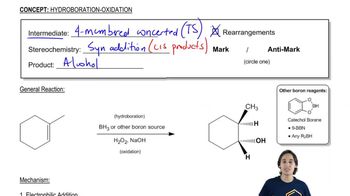
Hydroboration-Oxidation

Hydroboration-oxidation is a two-step reaction that converts alkenes into alcohols. In the first step, borane (BH₃) adds across the double bond of the alkene, resulting in a trialkylborane intermediate. The second step involves oxidation with hydrogen peroxide (H₂O₂) in a basic solution, which replaces the boron atom with a hydroxyl group, yielding an alcohol. This reaction is notable for its syn-addition mechanism, leading to specific stereochemical outcomes.
Video consigliato:
06:38
General properties of hydroboration-oxidation.

Stereochemistry

Stereochemistry refers to the spatial arrangement of atoms in molecules and how this affects their chemical behavior. In the context of hydroboration-oxidation, the reaction proceeds with syn-addition, meaning that the boron and hydrogen atoms add to the same side of the double bond. This results in a specific stereochemical configuration of the resulting alcohol, which is crucial for predicting the product's properties and reactivity.
Video consigliato:
Percorso guidato
1:38
Polymer Stereochemistry Concept 1

Regioselectivity

Regioselectivity is the preference of a chemical reaction to yield one structural isomer over others when multiple possibilities exist. In hydroboration-oxidation, the boron atom adds to the less substituted carbon of the alkene, leading to the formation of the more stable, less sterically hindered alcohol. Understanding regioselectivity is essential for predicting the outcome of the reaction and ensuring the desired alcohol is produced.
Video consigliato:
05:09
Heck Reaction