Ch. 9 - Alkenes 2: Oxidation and Reduction
Mullins - Organic Chemistry: A Learner Centered Approach 1st Edition
Mullins1st EditionOrganic Chemistry: A Learner Centered ApproachISBN: 9780137566471Non è quello che usi tu?Cambia libro di testo
Capitolo 8, Problema 7

Calculate the atom economy for the reactions shown. In each, what happens to the percentage of material that is not incorporated into the major product?

Guida verificata passo dopo passo
1
Step 1: Identify the major product of the reaction.
Step 2: Determine the molecular weight of the major product using the molecular formula.
Step 3: Calculate the total molecular weight of all reactants used in the reaction.
Step 4: Use the formula for atom economy: \( \text{Atom Economy} = \left( \frac{\text{Molecular Weight of Major Product}}{\text{Total Molecular Weight of Reactants}} \right) \times 100 \% \).
Step 5: Analyze the percentage of material not incorporated into the major product by subtracting the atom economy from 100%.

Risposta video verificata per un problema simile:

Questa soluzione video è stata consigliata dai nostri tutor come utile per risolvere questo problema.
Durata del video:
2m

Concetti chiave

Ecco i concetti essenziali che devi comprendere per rispondere correttamente alla domanda.

Atom Economy

Atom economy is a measure of the efficiency of a chemical reaction in terms of how well the reactants are converted into useful products. It is calculated by dividing the molar mass of the desired product by the total molar mass of all reactants, then multiplying by 100 to get a percentage. A higher atom economy indicates that a greater proportion of the reactants are incorporated into the final product, which is desirable for sustainable chemistry.
Video consigliato:
01:44
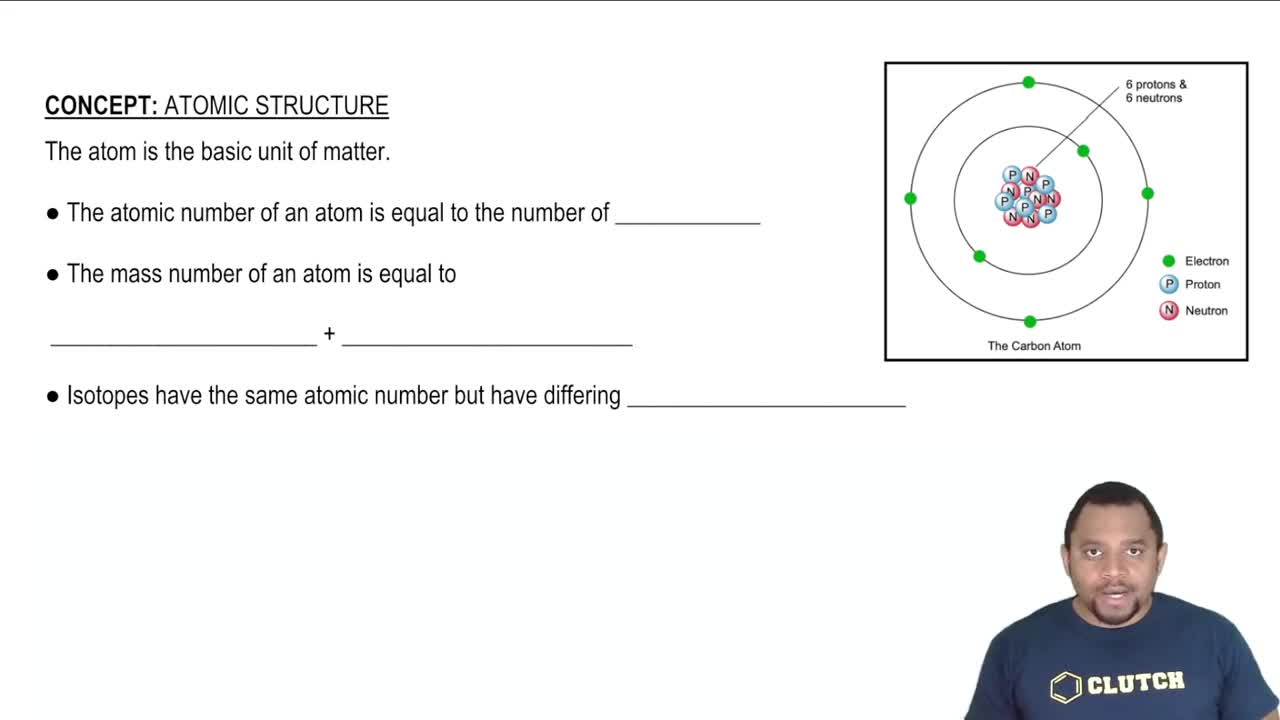
The difference between atomic numbers and atomic mass.

By-products

By-products are substances that are produced in a chemical reaction alongside the desired product but are not the main focus of the reaction. Understanding by-products is crucial for calculating atom economy, as they represent the material that does not contribute to the desired outcome. Analyzing the formation of by-products helps in assessing the efficiency and environmental impact of a reaction.
Video consigliato:
11:07
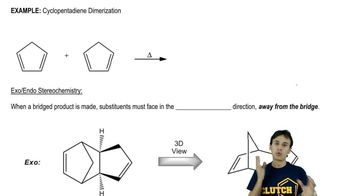
Bridged-Products

Reaction Mechanism

A reaction mechanism describes the step-by-step sequence of elementary reactions that occur during a chemical transformation. It provides insight into how reactants are converted into products, including the formation of intermediates and by-products. Understanding the mechanism is essential for predicting the atom economy, as it reveals which reactants are ultimately incorporated into the major product and which are lost as by-products.
Video consigliato:
02:16
Heck Reaction Mechanism