Ch.1 - Structure and Bonding
Wade - Organic Chemistry 9th Edition
Wade9th EditionOrganic ChemistryISBN: 9780135213728Non è quello che usi tu?Cambia libro di testo
Capitolo 1, Problema 55a,b

Draw orbital pictures of the pi bonding in the following compounds:
a. CH3COCH3
b. HCN

Guida verificata passo dopo passo
1
Step 1: Identify the pi bonds in each compound. For CH3COCH3 (acetone), the pi bond is between the carbon and oxygen in the carbonyl group. For HCN (hydrogen cyanide), the pi bond is between the carbon and nitrogen atoms.
Step 2: For CH3COCH3, draw the carbonyl group. The carbon atom is sp2 hybridized, forming a sigma bond with oxygen and two other sigma bonds with the methyl groups. The remaining p orbital on carbon overlaps with a p orbital on oxygen to form the pi bond.
Step 3: Represent the pi bond in CH3COCH3 using orbital pictures. Show the side-by-side overlap of the p orbitals on carbon and oxygen. Use MathML to depict the orbital overlap: p-p.
Step 4: For HCN, identify the hybridization of the carbon and nitrogen atoms. Carbon is sp hybridized, forming a sigma bond with hydrogen and another sigma bond with nitrogen. The remaining two p orbitals on carbon overlap with two p orbitals on nitrogen to form two pi bonds.
Step 5: Draw the orbital picture for HCN. Show the linear arrangement with the carbon and nitrogen atoms, and depict the side-by-side overlap of the p orbitals forming the pi bonds. Use MathML to represent the orbital overlap: p-p.

Risposta video verificata per un problema simile:

Questa soluzione video è stata consigliata dai nostri tutor come utile per risolvere questo problema.
Durata del video:
4m

Concetti chiave

Ecco i concetti essenziali che devi comprendere per rispondere correttamente alla domanda.

Pi Bonding

Pi bonding occurs when the orbitals of adjacent atoms overlap sideways, forming a bond above and below the plane of the atoms. It is typically found in double and triple bonds, where one sigma bond is accompanied by one or more pi bonds. Pi bonds are less strong than sigma bonds due to the less effective overlap of orbitals.
Video consigliato:
01:05
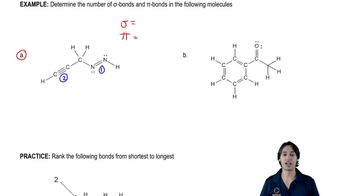
Sigma bonds and pi bonds

Orbital Hybridization

Orbital hybridization is the concept of mixing atomic orbitals to form new hybrid orbitals suitable for the pairing of electrons to form chemical bonds. In organic molecules, common hybridizations include sp3, sp2, and sp, which correspond to tetrahedral, trigonal planar, and linear geometries, respectively. Understanding hybridization helps predict molecular geometry and bonding properties.
Video consigliato:
04:58
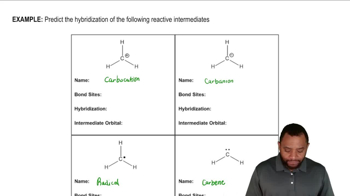
Bond sites, hybridization, and intermediate orbitals

Molecular Geometry

Molecular geometry refers to the three-dimensional arrangement of atoms within a molecule. It is determined by the number of bonds and lone pairs around the central atom, influencing the molecule's shape and reactivity. For example, acetone (CH3COCH3) has a trigonal planar geometry around the carbonyl carbon, while hydrogen cyanide (HCN) is linear due to sp hybridization.
Video consigliato:
07:44
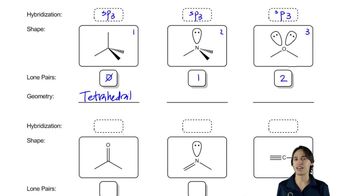
Molecular Geometry Explained.