
Ch. 2 - Acids and Bases; Functional Groups
Wade - Organic Chemistry 9th Edition
Wade9th EditionOrganic ChemistryISBN: 9780135213728Non è quello che usi tu?Cambia libro di testo
Capitolo 2, Problema 8

Calculate the pH of the following solutions.
a. 5.00 g of HBr in 100 mL of aqueous solution
b. 1.50 g of NaOH in 50 mL of aqueous solution

Guida verificata passo dopo passo
1
Step 1: Begin by calculating the molarity of the HBr solution. First, determine the number of moles of HBr using its molar mass. The molar mass of HBr is approximately 80.91 g/mol. Use the formula: \( \text{moles of HBr} = \frac{\text{mass of HBr}}{\text{molar mass of HBr}} \).
Step 2: Convert the volume of the solution from milliliters to liters. Since the volume is given as 100 mL, convert it to liters by dividing by 1000: \( \text{volume in liters} = \frac{100}{1000} \).
Step 3: Calculate the molarity of the HBr solution using the formula: \( \text{molarity} = \frac{\text{moles of HBr}}{\text{volume in liters}} \). Since HBr is a strong acid, it dissociates completely in water, and the concentration of \( \text{H}^+ \) ions will be equal to the molarity of the HBr solution.
Step 4: Calculate the pH of the HBr solution using the formula: \( \text{pH} = -\log[\text{H}^+] \), where \([\text{H}^+]\) is the molarity of the HBr solution.
Step 5: For the NaOH solution, repeat a similar process. Calculate the moles of NaOH using its molar mass (approximately 40.00 g/mol). Convert the volume from mL to liters (50 mL to 0.050 L). Calculate the molarity of NaOH, and since NaOH is a strong base, it dissociates completely, providing \([\text{OH}^-]\) equal to the molarity. Use the formula \( \text{pOH} = -\log[\text{OH}^-] \) and then find the pH using \( \text{pH} = 14 - \text{pOH} \).

Risposta video verificata per un problema simile:

Questa soluzione video è stata consigliata dai nostri tutor come utile per risolvere questo problema.
Durata del video:
7m

Concetti chiave

Ecco i concetti essenziali che devi comprendere per rispondere correttamente alla domanda.

Molarity

Molarity is a measure of the concentration of a solute in a solution, expressed as moles of solute per liter of solution (mol/L). To calculate molarity, you need to know the amount of solute in moles and the volume of the solution in liters. This concept is crucial for determining the concentration of HBr and NaOH in the given solutions.
Video consigliato:
Percorso guidato
1:39
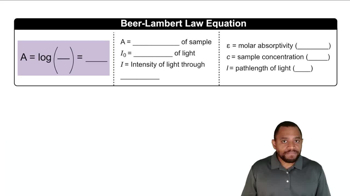
The Beer-Lambert Law Concept 2

pH Calculation

pH is a measure of the acidity or basicity of a solution, calculated as the negative logarithm of the hydrogen ion concentration (-log[H+]). For strong acids like HBr, which dissociate completely, the concentration of H+ ions is equal to the molarity of the acid. For strong bases like NaOH, the concentration of OH- ions can be used to find pH by first calculating pOH and then using the relation pH + pOH = 14.
Video consigliato:
04:37
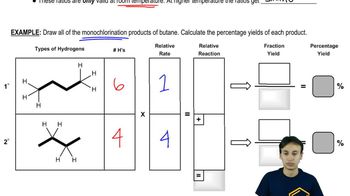
Draw all of the monochlorination products and calculate percentage yields.

Strong Acid and Base Dissociation

Strong acids and bases dissociate completely in aqueous solutions, meaning they fully ionize into their constituent ions. HBr, a strong acid, dissociates into H+ and Br- ions, while NaOH, a strong base, dissociates into Na+ and OH- ions. Understanding this complete dissociation is essential for accurately calculating the concentration of ions in the solution, which directly affects the pH.
Video consigliato:
03:10
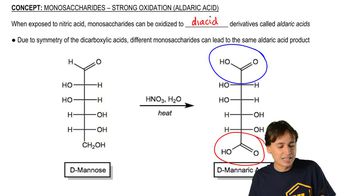
Monosaccharides - Strong Oxidation (Aldaric Acid)
Pratica correlata
Domanda del libro di testo

Ammonia appears in [TABLE 2-2 ] as both an acid and a conjugate base. a. Explain how ammonia can act as both an acid and a base. Which of these roles does it commonly fill in aqueous solutions?

b. Show how water can serve as both an acid and a base.

2235
views
Domanda del libro di testo

Ammonia appears in [TABLE 2-2] as both an acid and a conjugate base.

d. Show how methanol (CH3OH) can serve as both an acid and a base. Write an equation for the reaction of methanol with sulfuric acid.

1026
views
Domanda del libro di testo

Circle the member of each pair that is more soluble in water.

a. CH3CH2OCH2CH3 or CH3CH2CH2CH2CH3

b. CH3CH2OCH2CH3 or CH3CH2CH2OH

c. CH3CH2NHCH3 or CH3CH2CH2CH3

d. CH3CH2OH or CH3CH2CH2CH2OH

e.

2161
views
Domanda del libro di testo

For each pair of compounds, circle the compound you expect to have the higher boiling point. Explain your reasoning.

(d) HOCH2—(CH2)4—CH2OH or (CH3)3CCH(OH)CH3

(e) (CH3CH2CH2)2NH or (CH3CH2)3N

(f)

868
views
Domanda del libro di testo

Write equations for the following acid–base reactions. Use the information in Table 2-2 or Appendix 4 to predict whether the equilibrium will favor the reactants or the products.

a. HCOOH + –CN

b. CH3COO– + CH3OH

c. (CH3)2CHOH + NaNH2

2498
views
Domanda del libro di testo

For each pair of compounds, circle the compound you expect to have the higher boiling point. Explain your reasoning.

a. (CH3)3C—C(CH3)3 or (CH3)2CH—CH2CH2—CH(CH3)2

b. CH3(CH2)6CH3 or CH3(CH2)5CH2OH

c. CH3CH2OCH2CH3 or CH3CH2CH2CH2OH

2338
views
2
rank