Ch.10 - Structure and Synthesis of Alcohols
Wade - Organic Chemistry 9th Edition
Wade9th EditionOrganic ChemistryISBN: 9780135213728Non è quello che usi tu?Cambia libro di testo
Capitolo 10, Problema 14a

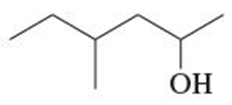
Show two ways you could synthesize each of the following secondary alcohol by adding an appropriate Grignard reagent to an aldehyde.
(a)

Guida verificata passo dopo passo
1
Step 1: Identify the target secondary alcohol structure. The first image shows a secondary alcohol with the hydroxyl group (-OH) attached to a carbon that is bonded to two other carbons. The second image also shows a secondary alcohol with a similar arrangement.
Step 2: Recall the general mechanism of Grignard reagent addition to aldehydes. A Grignard reagent (R-MgX) reacts with an aldehyde to form a secondary alcohol after protonation. The key is to choose the appropriate aldehyde and Grignard reagent combination to achieve the desired structure.
Step 3: For the first structure, one synthesis route involves using acetaldehyde (CH₃CHO) as the aldehyde and a Grignard reagent such as isopropyl magnesium bromide ((CH₃)₂CH-MgBr). The Grignard reagent adds to the carbonyl carbon of acetaldehyde, forming the secondary alcohol after protonation.
Step 4: Another synthesis route for the first structure involves using propanal (CH₃CH₂CHO) as the aldehyde and methyl magnesium bromide (CH₃-MgBr) as the Grignard reagent. The Grignard reagent adds to the carbonyl carbon of propanal, forming the secondary alcohol after protonation.
Step 5: For the second structure, one synthesis route involves using butanal (CH₃CH₂CH₂CHO) as the aldehyde and isopropyl magnesium bromide ((CH₃)₂CH-MgBr) as the Grignard reagent. Another route involves using isobutyraldehyde ((CH₃)₂CHCHO) as the aldehyde and ethyl magnesium bromide (CH₃CH₂-MgBr) as the Grignard reagent. Both combinations yield the desired secondary alcohol after protonation.

Risposta video verificata per un problema simile:

Questa soluzione video è stata consigliata dai nostri tutor come utile per risolvere questo problema.
Durata del video:
4m

Concetti chiave

Ecco i concetti essenziali che devi comprendere per rispondere correttamente alla domanda.

Grignard Reagents

Grignard reagents are organomagnesium compounds that are highly reactive and used in organic synthesis to form carbon-carbon bonds. They are created by reacting an alkyl or aryl halide with magnesium metal in anhydrous ether. When added to carbonyl compounds like aldehydes, they can lead to the formation of alcohols after hydrolysis.
Video consigliato:
02:12
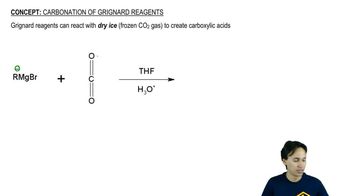
Carbonation of Grignard Reagents

Aldehyde Reactivity

Aldehydes are carbonyl compounds characterized by a carbon atom double-bonded to an oxygen atom and single-bonded to a hydrogen atom. They are more reactive than ketones due to the presence of the hydrogen atom, which makes them susceptible to nucleophilic attack by Grignard reagents. This reactivity is crucial for synthesizing secondary alcohols.
Video consigliato:
01:34
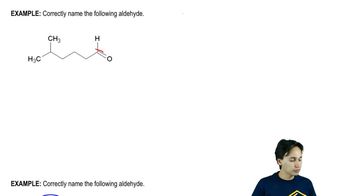
Name the aldehyde

Synthesis of Secondary Alcohols

Secondary alcohols can be synthesized by the reaction of Grignard reagents with aldehydes. The Grignard reagent acts as a nucleophile, attacking the carbonyl carbon of the aldehyde, leading to the formation of a tetrahedral intermediate. Upon hydrolysis, this intermediate yields a secondary alcohol, which is characterized by having the hydroxyl group (-OH) attached to a carbon that is bonded to two other carbons.
Video consigliato:
01:44
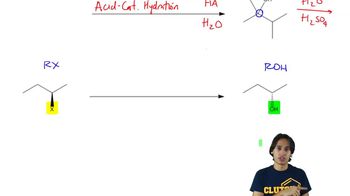
Forming alcohols through SN2 reactions.