
Ch.10 - Structure and Synthesis of Alcohols
Wade - Organic Chemistry 9th Edition
Wade9th EditionOrganic ChemistryISBN: 9780135213728Non è quello che usi tu?Cambia libro di testo
Capitolo 10, Problema 10a

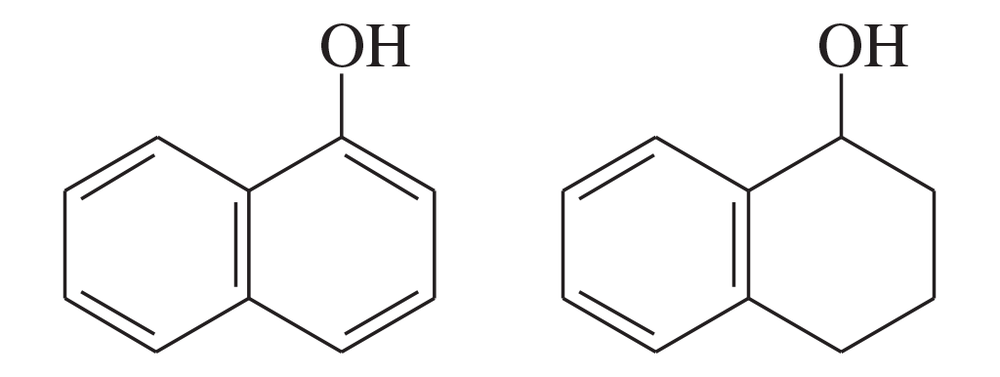
The following compounds are only slightly soluble in water, but one of them is very soluble in a dilute aqueous solution of sodium hydroxide. The other is still only slightly soluble.

(a) Explain the difference in solubility of these compounds in dilute sodium hydroxide.

Guida verificata passo dopo passo
1
Step 1: Analyze the chemical structures of the two compounds. Compound A is cyclohexanol, which contains a hydroxyl (-OH) group attached to a saturated cyclohexane ring. Compound B is phenol, which contains a hydroxyl (-OH) group attached to an aromatic benzene ring.
Step 2: Discuss the acidity of the hydroxyl group in each compound. In phenol (Compound B), the aromatic ring stabilizes the negative charge on the oxygen atom after deprotonation due to resonance. This makes phenol more acidic compared to cyclohexanol (Compound A), which lacks resonance stabilization.
Step 3: Explain the reaction with sodium hydroxide. Phenol (Compound B), being more acidic, reacts with dilute sodium hydroxide to form phenoxide ion (C₆H₅O⁻), which is highly soluble in water. Cyclohexanol (Compound A), being less acidic, does not react significantly with sodium hydroxide and remains only slightly soluble.
Step 4: Highlight the solubility difference. The formation of the phenoxide ion increases the solubility of phenol in dilute sodium hydroxide, whereas cyclohexanol does not form a similar ion and remains slightly soluble.
Step 5: Conclude the explanation. The difference in solubility arises from the acidity of the compounds and their ability to react with sodium hydroxide. Phenol's aromatic ring allows it to form a soluble phenoxide ion, while cyclohexanol does not undergo such a reaction.

Risposta video verificata per un problema simile:

Questa soluzione video è stata consigliata dai nostri tutor come utile per risolvere questo problema.
Durata del video:
5m

Concetti chiave

Ecco i concetti essenziali che devi comprendere per rispondere correttamente alla domanda.

Phenolic Compounds

Phenolic compounds are organic compounds characterized by the presence of a hydroxyl group (-OH) attached to an aromatic hydrocarbon ring. Their solubility in water can vary significantly based on the structure of the compound, particularly the presence of additional functional groups that can interact with water or other solvents.
Video consigliato:
02:27
Identify the most acidic phenol

Solubility in Aqueous Solutions

The solubility of a compound in water or aqueous solutions is influenced by its ability to form hydrogen bonds and interact with water molecules. Compounds that can ionize or form strong interactions with water tend to be more soluble. In this case, the presence of sodium hydroxide can lead to deprotonation of phenolic compounds, increasing their solubility.
Video consigliato:
02:01
Introducing common solvents and other molecules in organic chemistry.

Deprotonation and Ionization

Deprotonation is the removal of a proton (H+) from a molecule, which can lead to the formation of an ion. In the context of phenolic compounds, when treated with sodium hydroxide, one compound may lose its hydroxyl proton, becoming negatively charged and thus more soluble in water. The other compound may not undergo this reaction, remaining largely insoluble.
Video consigliato:
04:28
Ionization Potentials
Pratica correlata
Domanda del libro di testo

A nitro group (–NO2) effectively stabilizes a negative charge on an adjacent carbon atom through resonance:

Two of the following nitrophenols are much more acidic than phenol itself. The third compound is only slightly more acidic than phenol. Use resonance structures of the appropriate phenoxide ions to show why two of these anions should be unusually stable.

3684
views
Domanda del libro di testo

Without looking them up, rank the following compounds in decreasing order of acidity. These examples represent large classes of compounds that differ widely in acidity.

water, ethanol, 2-chloroethanol, tert-butyl alcohol, ammonia, sulfuric acid, hexane, hex-1-yne, acetic acid

875
views
Domanda del libro di testo

Predict the products of the following reactions.

(a)

(b)

838
views
Domanda del libro di testo
For each molecular formula, draw all the possible constitutional isomers of alcohols with that formula. Give the IUPAC name for each alcohol. (a) C3H8O (b) C4H10O (c) C3H6O (d) C3H4O
1190
views
Domanda del libro di testo

The following compounds are only slightly soluble in water, but one of them is very soluble in a dilute aqueous solution of sodium hydroxide. The other is still only slightly soluble.

(b) Show how this difference might be exploited to separate a mixture of these two compounds using a separatory funnel.

1555
views
Domanda del libro di testo

Which of the following compounds are suitable solvents for Grignard reactions?

(a) n-hexane

(b) CH3–O–CH3

(c) CHCl3

(d) cyclohexane

(e) benzene

(f) CH3OCH2CH2OCH3

(g)

(h)

2064
views