Ch.11 - Reactions of Alcohols
Wade - Organic Chemistry 9th Edition
Wade9th EditionOrganic ChemistryISBN: 9780135213728Non è quello che usi tu?Cambia libro di testo
Capitolo 11, Problema 2g,h

Predict the products of the reactions of the following compounds with:
1. chromic acid or excess sodium hypochlorite with acetic acid.
2. PCC or NaOCl (1 equivalent) with TEMPO.
g. hexan-1-ol
h. acetaldehyde, CH3CHO

Guida verificata passo dopo passo
1
Step 1: Understand the reagents and their roles. Chromic acid (H2CrO4) and excess sodium hypochlorite (NaOCl) with acetic acid are strong oxidizing agents. PCC (Pyridinium Chlorochromate) and NaOCl with TEMPO are mild oxidizing agents. Strong oxidizing agents can fully oxidize primary alcohols to carboxylic acids, while mild oxidizing agents typically stop at aldehydes.
Step 2: Analyze the structure of hexan-1-ol (g). Hexan-1-ol is a primary alcohol. When treated with chromic acid or excess NaOCl with acetic acid, it will be oxidized to hexanoic acid (a carboxylic acid). When treated with PCC or NaOCl (1 equivalent) with TEMPO, it will be oxidized to hexanal (an aldehyde).
Step 3: Analyze the structure of acetaldehyde (h), CH3CHO. Acetaldehyde is already an aldehyde. Strong oxidizing agents like chromic acid or excess NaOCl with acetic acid will oxidize it further to acetic acid (CH3COOH). Mild oxidizing agents like PCC or NaOCl with TEMPO will not oxidize it further, as aldehydes are typically stable under mild conditions.
Step 4: Write the balanced chemical equations for each reaction. For hexan-1-ol with chromic acid: \( \text{C}_6\text{H}_{13}\text{OH} + H_2CrO_4 \rightarrow \text{C}_6\text{H}_{12}\text{COOH} \). For hexan-1-ol with PCC: \( \text{C}_6\text{H}_{13}\text{OH} + PCC \rightarrow \text{C}_6\text{H}_{12}\text{CHO} \). For acetaldehyde with chromic acid: \( \text{CH}_3\text{CHO} + H_2CrO_4 \rightarrow \text{CH}_3\text{COOH} \).
Step 5: Summarize the expected products. Hexan-1-ol reacts with strong oxidizing agents to form hexanoic acid and with mild oxidizing agents to form hexanal. Acetaldehyde reacts with strong oxidizing agents to form acetic acid but remains unchanged with mild oxidizing agents.

Risposta video verificata per un problema simile:

Questa soluzione video è stata consigliata dai nostri tutor come utile per risolvere questo problema.
Durata del video:
5m

Concetti chiave

Ecco i concetti essenziali che devi comprendere per rispondere correttamente alla domanda.

Oxidation Reactions

Oxidation reactions involve the loss of electrons or an increase in oxidation state of a molecule. In organic chemistry, this often pertains to the conversion of alcohols to aldehydes or ketones, and further to carboxylic acids. Understanding the specific oxidizing agents, such as chromic acid or PCC, is crucial as they dictate the extent of oxidation and the resulting products.
Video consigliato:
03:20
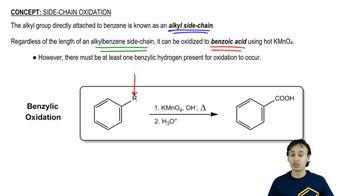
Benzylic Oxidation

Reactivity of Alcohols and Aldehydes

Alcohols and aldehydes exhibit distinct reactivity patterns due to their functional groups. Hexan-1-ol, a primary alcohol, can be oxidized to an aldehyde or carboxylic acid, while acetaldehyde can undergo further oxidation to acetic acid. Recognizing these transformations is essential for predicting the products of reactions with oxidizing agents.
Video consigliato:
01:34
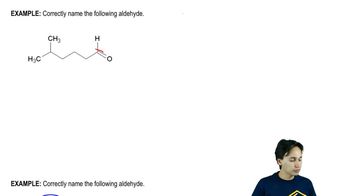
Name the aldehyde

Role of Oxidizing Agents

Different oxidizing agents have varying strengths and selectivities. For instance, chromic acid is a strong oxidizer that can fully oxidize primary alcohols to carboxylic acids, while PCC is milder and typically oxidizes primary alcohols to aldehydes. Sodium hypochlorite (NaOCl) can also oxidize alcohols and aldehydes, but its reactivity can depend on the conditions and the presence of other reagents like TEMPO, which can influence the reaction pathway.
Video consigliato:
03:40
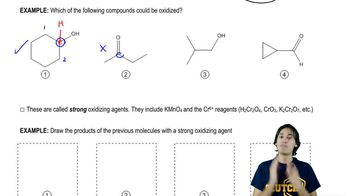
Strong oxidizing agents
Pratica correlata
Domanda del libro di testo

Predict the products of the reactions of the following compounds with:

1. chromic acid or excess sodium hypochlorite with acetic acid.

2. PCC or NaOCl (1 equivalent) with TEMPO.

d. cyclohexanone

982
views

Domanda del libro di testo

We have covered several oxidants that use a multi-valent atom (Cr, Cl, S, or I) as their active species, going from a higher oxidation state before the oxidation to a lower oxidation state after oxidizing the alcohol. Draw the Lewis structures of the following atoms, before and after the oxidation of an alcohol to a ketone or aldehyde. How many bonds to oxygen does each atom have before and after the oxidation?

a. the Cr in chromic acid

b. the Cl in sodium hypochlorite

c. the S in the Swern oxidation

1057
views
Domanda del libro di testo

Predict the products of the reactions of the following compounds with:

1. chromic acid or excess sodium hypochlorite with acetic acid.

2. PCC or NaOCl (1 equivalent) with TEMPO.

e. cyclohexane

663
views
Domanda del libro di testo

Predict the products of the reactions of the following compounds with:

1. chromic acid or excess sodium hypochlorite with acetic acid.

2. PCC or NaOCl (1 equivalent) with TEMPO.

f. 1-phenylpropan-1-ol

681
views
Domanda del libro di testo

Give the structure of the principal product(s) when each of the following alcohols reacts with (3) DMP, and (4) 1 equiv NaOCl-TEMPO.

c. 4-hydroxydecanal

710
views
Domanda del libro di testo

Give the structure of the principal product(s) when each of the following alcohols reacts with (1) Na2Cr2O7/H2SO4, (2) PCC, (3) DMP, and (4) 1 equiv NaOCl-TEMPO.

a. octan-1-ol

b. octan-3-ol

1582
views