
Ch.11 - Reactions of Alcohols
Wade - Organic Chemistry 9th Edition
Wade9th EditionOrganic ChemistryISBN: 9780135213728Non è quello che usi tu?Cambia libro di testo
Capitolo 11, Problema 40g,h

Show how you would convert 2-methylcyclopentanol to the following products. Any of these products may be used as the reactant in any subsequent part of this problem.
(g) 2-methylcyclopentyl acetate
(h) 1-bromo-1-methylcyclopentane

Guida verificata passo dopo passo
1
Step 1: Begin with the starting compound, 2-methylcyclopentanol. To convert it into 2-methylcyclopentyl acetate (product g), perform an esterification reaction. React 2-methylcyclopentanol with acetic acid (CH₃COOH) in the presence of an acid catalyst, such as concentrated sulfuric acid (H₂SO₄). This will result in the formation of the ester, 2-methylcyclopentyl acetate, through a nucleophilic acyl substitution mechanism.
Step 2: To prepare 1-bromo-1-methylcyclopentane (product h), start with 2-methylcyclopentanol and perform a substitution reaction. First, convert the alcohol group (-OH) into a better leaving group by reacting it with a reagent like phosphorus tribromide (PBr₃) or thionyl chloride (SOCl₂) in the presence of pyridine. This step will replace the hydroxyl group with a bromine atom, forming 1-bromo-1-methylcyclopentane.
Step 3: If needed, you can use 2-methylcyclopentyl acetate (product g) as a reactant for further transformations. For example, hydrolyze the ester under acidic or basic conditions to regenerate 2-methylcyclopentanol, which can then be used for other reactions.
Step 4: Similarly, 1-bromo-1-methylcyclopentane (product h) can be used as a reactant for further reactions. For instance, it can undergo elimination reactions (e.g., with a strong base like KOH in ethanol) to form alkenes, or it can participate in nucleophilic substitution reactions to introduce other functional groups.
Step 5: Ensure that reaction conditions (e.g., temperature, solvent, and catalyst) are carefully controlled in each step to maximize yield and minimize side reactions. Use spectroscopic techniques like IR, NMR, or GC-MS to confirm the identity of the products at each stage.

Risposta video verificata per un problema simile:

Questa soluzione video è stata consigliata dai nostri tutor come utile per risolvere questo problema.
Durata del video:
6m

Concetti chiave

Ecco i concetti essenziali che devi comprendere per rispondere correttamente alla domanda.

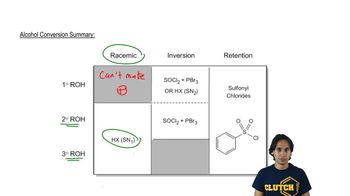
Alcohol Conversion

Converting alcohols to other functional groups is a fundamental reaction in organic chemistry. In this case, 2-methylcyclopentanol can be transformed into various derivatives through reactions such as esterification or halogenation. Understanding the mechanisms of these reactions, including the role of reagents and conditions, is crucial for predicting the products formed.
Video consigliato:
04:30
Comparing and contrasting the Alcohol Conversions.

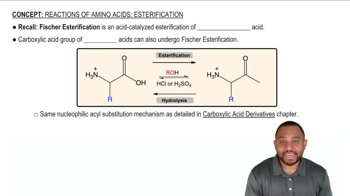
Esterification

Esterification is a reaction where an alcohol reacts with a carboxylic acid or an acid derivative to form an ester. In the context of converting 2-methylcyclopentanol to 2-methylcyclopentyl acetate, this process typically involves the use of acetic acid and an acid catalyst. Recognizing the conditions that favor ester formation, such as heat and removal of water, is essential for successful synthesis.
Video consigliato:
Percorso guidato
1:21
Reactions of Amino Acids: Esterification Concept 1

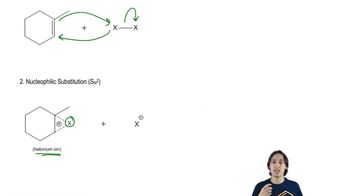
Halogenation

Halogenation refers to the introduction of halogen atoms into organic compounds, often through radical or electrophilic mechanisms. To convert 2-methylcyclopentanol to 1-bromo-1-methylcyclopentane, a common method involves converting the alcohol to a better leaving group, such as a bromide, using reagents like phosphorus tribromide (PBr3). Understanding the selectivity and regioselectivity of halogenation reactions is key to achieving the desired product.
Video consigliato:
03:45
Halogenation Mechanism