Ch.11 - Reactions of Alcohols
Wade - Organic Chemistry 9th Edition
Wade9th EditionOrganic ChemistryISBN: 9780135213728Non è quello che usi tu?Cambia libro di testo
Capitolo 11, Problema 56h

Show how you would synthesize the following compounds. As starting materials, you may use any alcohols containing four or fewer carbon atoms, cyclohexanol, and any necessary solvents and inorganic reagents.
(h) Chemical structure diagram showing a compound with a carbon chain and cyclohexanol, indicating hydroxyl groups.

Guida verificata passo dopo passo
1
Step 1: Begin with cyclohexanol as the starting material. Cyclohexanol contains a hydroxyl group (-OH) attached to a cyclohexane ring, which will serve as the base structure for the target compound.
Step 2: Perform a dihydroxylation reaction on cyclohexanol to introduce two hydroxyl groups on adjacent carbons of the cyclohexane ring. This can be achieved using reagents such as osmium tetroxide (OsO₄) followed by hydrogen peroxide (H₂O₂) in water.
Step 3: To introduce the isopropyl group (CH(CH₃)₂) and the ethoxy group (-OCH₂CH₃) on the same carbon, start with a primary alcohol such as ethanol (CH₃CH₂OH). Convert ethanol into ethyl bromide (CH₃CH₂Br) using phosphorus tribromide (PBr₃).
Step 4: React isopropyl alcohol (CH₃CH(OH)CH₃) with ethyl bromide in the presence of a strong base such as sodium hydride (NaH) to form the desired ether bond (-CH₂CH₃). This step creates the ethoxy group attached to the isopropyl group.
Step 5: Finally, attach the isopropyl-ethoxy group to the cyclohexane ring by performing a nucleophilic substitution reaction. Use a strong base to deprotonate one of the hydroxyl groups on the cyclohexane ring, making it a nucleophile, which can then attack the carbon atom of the isopropyl-ethoxy group.

Risposta video verificata per un problema simile:

Questa soluzione video è stata consigliata dai nostri tutor come utile per risolvere questo problema.
Durata del video:
13m

Concetti chiave

Ecco i concetti essenziali che devi comprendere per rispondere correttamente alla domanda.

Alcohols as Reactants

Alcohols are organic compounds containing one or more hydroxyl (-OH) groups. In synthesis, they can undergo various reactions such as dehydration, oxidation, or substitution to form different compounds. Understanding the reactivity of alcohols, especially those with four or fewer carbon atoms, is crucial for planning synthetic pathways.
Video consigliato:
01:01
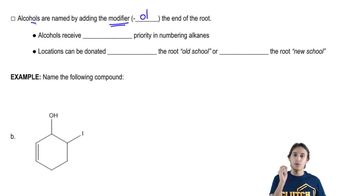
How to name alcohols

Functional Group Transformations

Functional group transformations involve converting one functional group into another through chemical reactions. This is essential in organic synthesis, as it allows chemists to modify the structure and properties of molecules. Familiarity with common transformations, such as converting alcohols to aldehydes or ketones, is vital for synthesizing the desired compounds.
Video consigliato:
02:36
Identifying Functional Groups

Reagents and Solvents in Organic Synthesis

Reagents and solvents play a critical role in organic synthesis, influencing reaction rates, yields, and selectivity. In the context of synthesizing compounds from alcohols, knowing which inorganic reagents (like acids or bases) and solvents (like water or organic solvents) to use is essential for optimizing the reaction conditions and achieving the desired products.
Video consigliato:
01:16
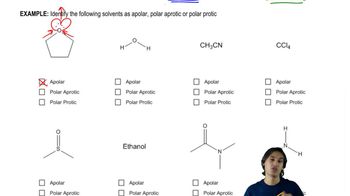
Identification of polarity in solvents