
Ch.11 - Reactions of Alcohols
Wade - Organic Chemistry 9th Edition
Wade9th EditionOrganic ChemistryISBN: 9780135213728Non è quello che usi tu?Cambia libro di testo
Capitolo 11, Problema 20a,b

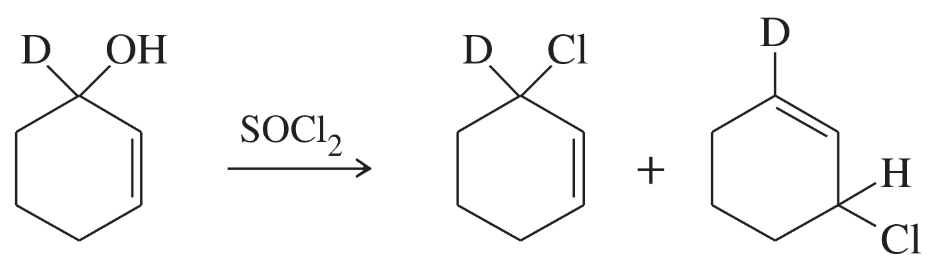
Two products are observed in the following reaction.

a. Suggest a mechanism to explain how these two products are formed.
b. Your mechanism for part (a) should be different from the usual mechanism of the reaction of SOCl2 with alcohols. Explain why the reaction follows a different mechanism in this case.

Guida verificata passo dopo passo
1
Step 1: Analyze the reaction. The starting material is an alcohol with a deuterium-labeled carbon adjacent to the hydroxyl group. The reaction involves SOCl2, which typically converts alcohols to alkyl chlorides. However, two products are formed, indicating an unusual mechanism.
Step 2: Suggest a mechanism for product formation. The reaction likely involves the formation of a carbocation intermediate due to the presence of SOCl2. The hydroxyl group is replaced by a chlorine atom, and the carbocation allows for rearrangement or elimination reactions.
Step 3: Explain the formation of the first product. The carbocation intermediate undergoes direct substitution, where the chlorine atom from SOCl2 attaches to the carbocation, forming the first product with the chlorine atom bonded to the original carbon.
Step 4: Explain the formation of the second product. The carbocation intermediate undergoes elimination, leading to the formation of a double bond. A chlorine atom then attaches to a different carbon, resulting in the second product.
Step 5: Address why the mechanism differs from the usual SOCl2 reaction. The presence of the deuterium-labeled carbon and the cyclic structure likely stabilizes the carbocation intermediate, allowing for rearrangement and elimination pathways that are not typical in linear alcohols reacting with SOCl2.

Risposta video verificata per un problema simile:

Questa soluzione video è stata consigliata dai nostri tutor come utile per risolvere questo problema.
Durata del video:
12m

Concetti chiave

Ecco i concetti essenziali che devi comprendere per rispondere correttamente alla domanda.

Mechanism of SOCl2 with Alcohols

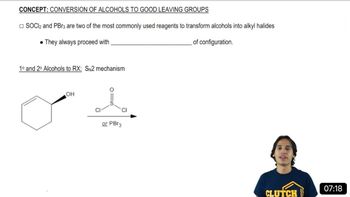
The reaction of thionyl chloride (SOCl2) with alcohols typically involves the formation of an alkyl chloride through a nucleophilic substitution mechanism. In this process, the hydroxyl group of the alcohol is replaced by a chloride ion, often via an intermediate that includes a sulfonate ester. Understanding this standard mechanism is crucial for analyzing deviations in product formation.
Video consigliato:
07:18
Learning the mechanism of SOCl2.

Deuterium Labeling

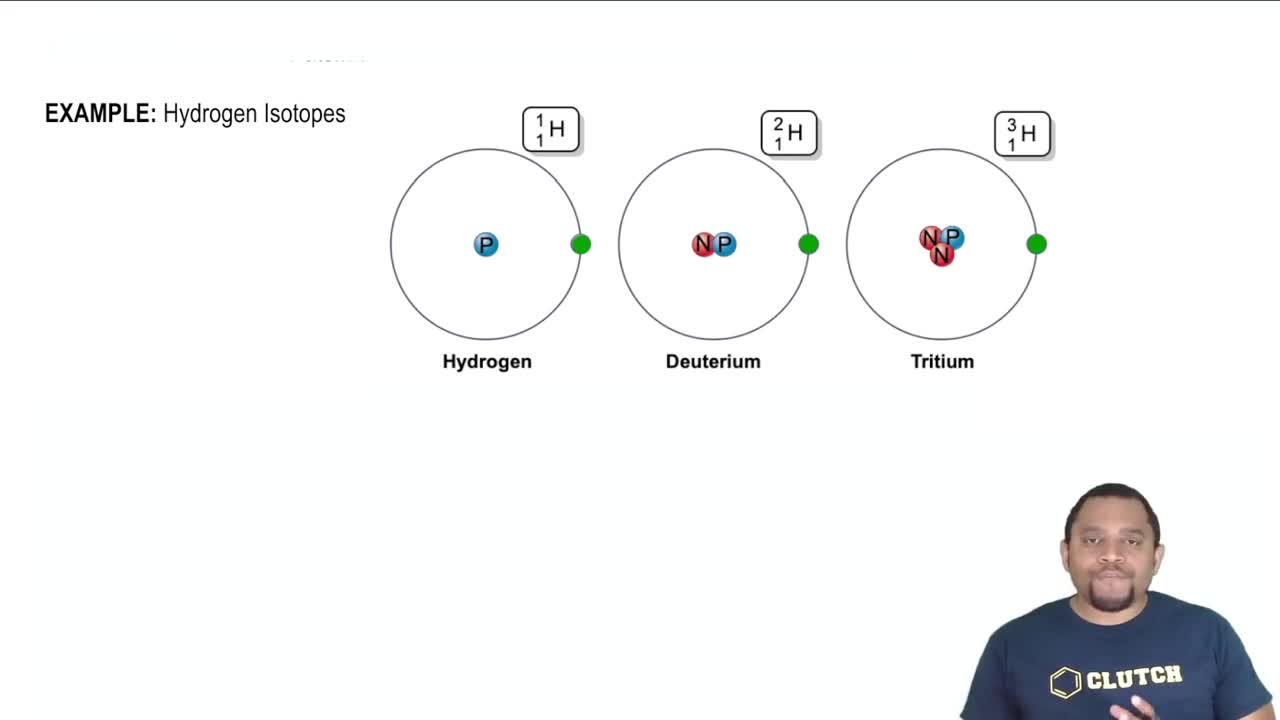
Deuterium (D) is a stable isotope of hydrogen that can be used to trace reaction pathways and mechanisms. In this reaction, the presence of deuterium in the starting material suggests that the mechanism may involve a rearrangement or elimination step that affects the distribution of deuterium in the products. This labeling can provide insights into the reaction dynamics and help differentiate between possible mechanisms.
Video consigliato:
03:06
Understanding the hydrogen isotopes.

Alternative Mechanisms in Organic Reactions

Organic reactions can often proceed via multiple mechanisms depending on the substrate and reaction conditions. In this case, the question suggests that the mechanism differs from the typical SOCl2 reaction with alcohols, possibly indicating a concerted mechanism or a rearrangement. Recognizing when and why alternative mechanisms occur is essential for predicting product formation and understanding reaction pathways.
Video consigliato:
02:17
Identifying organic molecules
Pratica correlata
Domanda del libro di testo

Predict the products of the sulfuric acid-catalyzed dehydration of the following alcohols. When more than one product is expected, label the major and minor products.

(d) 1-isopropylcyclohexanol

(e) 2-methylcyclohexanol

1131
views
1
rank
Domanda del libro di testo

Some alcohols undergo rearrangement or other unwanted side reactions when they dehydrate in acid. Alcohols may be dehydrated under mildly basic conditions using phosphorus oxy-chloride (POCl3) in pyridine. The alcohol reacts with phosphorus oxychloride much like it reacts with tosyl chloride (Section 11-5), displacing a chloride ion from phosphorus to give an alkyl dichlorophosphate ester. The dichlorophosphate group is an outstanding leaving group. Pyridine reacts as a base with the dichlorophosphate ester to give an E2 elimination. Propose a mechanism for the dehydration of cyclohexanol by POCl3 in pyridine.

2034
views
Domanda del libro di testo

Write balanced equations for the three preceding reactions.

1349
views
Domanda del libro di testo

Give the structures of the products you would expect when each alcohol reacts with (1) HCl, ZnCl2; (2) HBr; (3) PBr3; (4) P/I2; and (5) SOCl2.

(a) butan-1-ol

(b) 2-methylbutan-2-ol

1586
views
Domanda del libro di testo

When cis-2-methylcyclohexanol reacts with the Lucas reagent, the major product is 1-chloro-1-methylcyclohexane. Propose a mechanism to explain the formation of this product.

1165
views
Domanda del libro di testo

Suggest how you would convert trans-4-methylcyclohexanol to

a. trans-1-chloro-4-methylcyclohexane.

b. cis-1-chloro-4-methylcyclohexane.

1405
views