
Ch. 12 - Infrared Spectroscopy and Mass Spectrometry
Wade - Organic Chemistry 9th Edition
Wade9th EditionOrganic ChemistryISBN: 9780135213728Non è quello che usi tu?Cambia libro di testo
Capitolo 12, Problema 11

Account for the peaks at m/z 87, 111, and 126 in the mass spectrum of 2,6-dimethylheptan-4-ol.
<IMAGE>

Guida verificata passo dopo passo
1
Identify the molecular structure of 2,6-dimethylheptan-4-ol. It is a seven-carbon chain with methyl groups attached to carbons 2 and 6, and a hydroxyl (-OH) group attached to carbon 4.
Understand that the mass spectrum provides peaks corresponding to fragments of the molecule. The m/z values represent the mass-to-charge ratio of these fragments, typically resulting from cleavage of bonds in the molecule.
For the peak at m/z 87: Consider the cleavage of the molecule at the C4-C5 bond. This would result in a fragment containing the first four carbons (C1-C4) along with the hydroxyl group. Calculate the mass of this fragment by summing the atomic masses of its components.
For the peak at m/z 111: Consider the cleavage of the molecule at the C3-C4 bond. This would result in a fragment containing the first three carbons (C1-C3) and the hydroxyl group, along with the methyl group at C2. Calculate the mass of this fragment by summing the atomic masses of its components.
For the peak at m/z 126: This peak likely corresponds to the molecular ion (M+) of the compound, which represents the entire molecule with a single positive charge. Calculate the molecular mass of 2,6-dimethylheptan-4-ol by summing the atomic masses of all its atoms.

Risposta video verificata per un problema simile:

Questa soluzione video è stata consigliata dai nostri tutor come utile per risolvere questo problema.
Durata del video:
4m

Concetti chiave

Ecco i concetti essenziali che devi comprendere per rispondere correttamente alla domanda.

Mass Spectrometry

Mass spectrometry is an analytical technique used to measure the mass-to-charge ratio of ions. It involves ionizing chemical species and sorting the ions based on their mass. The resulting mass spectrum displays peaks corresponding to different ions, where the m/z (mass-to-charge) values indicate the mass of the ions detected. Understanding this technique is crucial for interpreting the peaks in the spectrum.
Video consigliato:
01:25
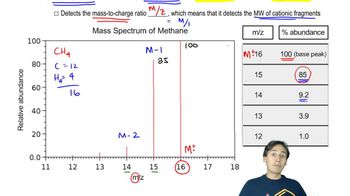
How to Read a Mass Spectrum

Fragmentation Patterns

Fragmentation patterns refer to the specific ways in which a molecule breaks apart into smaller ions during mass spectrometry. These patterns are influenced by the structure of the molecule and can provide insights into its composition. For 2,6-dimethylheptan-4-ol, the peaks at m/z 87, 111, and 126 likely correspond to specific fragments resulting from the cleavage of the molecular structure, which can help identify the compound.
Video consigliato:
08:06
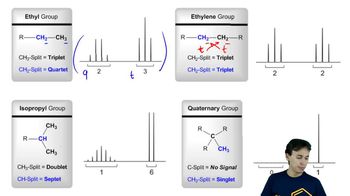
Common Splitting Patterns

Isomerism in Organic Compounds

Isomerism is the phenomenon where compounds with the same molecular formula have different structural arrangements or spatial orientations. In the case of 2,6-dimethylheptan-4-ol, understanding its isomers is essential for interpreting the mass spectrum, as different isomers can produce distinct fragmentation patterns and thus different m/z values. This concept aids in predicting and rationalizing the observed peaks in the mass spectrum.
Video consigliato:
01:40
Defining meso compounds.
Pratica correlata
Domanda del libro di testo

Ethers are not easily differentiated by their infrared spectra, but they tend to form predictable fragments in the mass spectrum. The following compounds give similar but distinctive mass spectra.

Both compounds give prominent peaks at m/z 116, 73, 57, and 43. But one compound gives a distinctive strong peak at 87, and the other compound gives a strong peak at 101. Determine which compound gives the peak at 87 and which one gives the peak at 101. Propose fragmentations to account for the ions at m/z 116, 101, 87, and 73.

1490
views
Domanda del libro di testo

Show the fragmentations that give rise to the peaks at m/z 43, 57, and 85 in the mass spectrum of 2,4-dimethylpentane (Figure 12-17).

<IMAGE>

2289
views
Domanda del libro di testo

Identify which of these four mass spectra indicate the presence of sulfur, chlorine, bromine, iodine, or nitrogen. Suggest a molecular formula for each.

<IMAGE>

1977
views
Domanda del libro di testo

Convert the following infrared wavelengths to cm-1. (a) 6.24 𝜇m, typical for an aromatic C=C (b) 3.38 𝜇m, typical for a saturated C-H bond (c) 5.85 𝜇m, typical for a ketone carbonyl

1509
views
Domanda del libro di testo

Predict the characteristic infrared absorptions of the functional groups in the following molecules.

(a) cyclohexene

(b) pentan-2-ol

(c) pentan-2-one

1256
views
Domanda del libro di testo

Predict the characteristic infrared absorptions of the functional groups in the following molecules.

(d) pent-1-yne

(e) diethylamine

(f) pentanoic acid

1412
views