
Ch. 13 - Nuclear Magnetic Resonance Spectroscopy
Wade - Organic Chemistry 9th Edition
Wade9th EditionOrganic ChemistryISBN: 9780135213728Non è quello che usi tu?Cambia libro di testo
Capitolo 13, Problema 39b

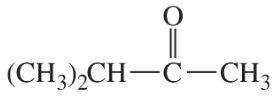
Sketch your predictions of the proton NMR spectra of the following compounds.
(b)

Guida verificata passo dopo passo
1
Step 1: Analyze the molecular structure of the compound (CH3)2CH-C(O)-CH3. This molecule contains three distinct types of hydrogen environments: (a) the hydrogens on the two methyl groups attached to the isopropyl group, (b) the hydrogen on the methine group (CH), and (c) the hydrogens on the methyl group attached to the carbonyl group.
Step 2: Predict the chemical shifts for each type of hydrogen environment. (a) The hydrogens on the methyl groups attached to the isopropyl group will appear as a single peak due to their equivalent environment, likely in the range of 0.9-1.2 ppm. (b) The hydrogen on the methine group (CH) will appear downfield due to the electron-withdrawing effect of the carbonyl group, likely in the range of 2.0-2.5 ppm. (c) The hydrogens on the methyl group attached to the carbonyl group will also appear downfield, likely in the range of 2.1-2.4 ppm.
Step 3: Determine the splitting patterns for each type of hydrogen environment. (a) The hydrogens on the methyl groups attached to the isopropyl group will experience splitting due to the adjacent methine hydrogen, resulting in a doublet. (b) The methine hydrogen will experience splitting due to the six hydrogens on the adjacent methyl groups, resulting in a septet. (c) The hydrogens on the methyl group attached to the carbonyl group will not experience splitting as there are no adjacent hydrogens, resulting in a singlet.
Step 4: Predict the integration values for each peak. (a) The hydrogens on the methyl groups attached to the isopropyl group will integrate to 6 protons. (b) The methine hydrogen will integrate to 1 proton. (c) The hydrogens on the methyl group attached to the carbonyl group will integrate to 3 protons.
Step 5: Combine all predictions to sketch the proton NMR spectrum. The spectrum will include: (a) a doublet for the methyl groups attached to the isopropyl group, (b) a septet for the methine hydrogen, and (c) a singlet for the methyl group attached to the carbonyl group. Ensure the chemical shifts, splitting patterns, and integration values are consistent with the analysis.

Risposta video verificata per un problema simile:

Questa soluzione video è stata consigliata dai nostri tutor come utile per risolvere questo problema.
Durata del video:
3m

Concetti chiave

Ecco i concetti essenziali che devi comprendere per rispondere correttamente alla domanda.

Proton NMR Spectroscopy

Proton Nuclear Magnetic Resonance (NMR) spectroscopy is a powerful analytical technique used to determine the structure of organic compounds. It provides information about the number of hydrogen atoms in different environments within a molecule, allowing chemists to infer connectivity and functional groups. Peaks in the NMR spectrum correspond to different types of hydrogen, with their chemical shifts indicating the electronic environment around them.
Video consigliato:
10:06
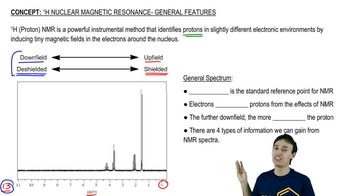
General NMR Features

Chemical Shifts

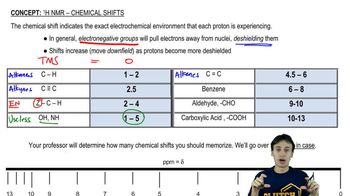
Chemical shifts in NMR spectroscopy refer to the position of the peaks in the spectrum, measured in parts per million (ppm). They provide insight into the electronic environment of hydrogen atoms, influenced by nearby electronegative atoms or functional groups. For example, hydrogens adjacent to a carbonyl group typically appear downfield (higher ppm) due to deshielding effects, which is crucial for predicting the NMR spectrum of the given compound.
Video consigliato:
11:44
1H NMR Chemical Shifts

Integration and Splitting Patterns

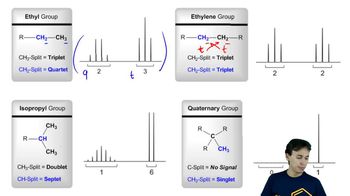
Integration in NMR refers to the area under the peaks, which correlates to the number of hydrogen atoms contributing to that signal. Splitting patterns arise from the interaction of neighboring hydrogen atoms, described by the n+1 rule, where n is the number of adjacent hydrogens. Understanding these patterns helps in deducing the number of hydrogen atoms in different environments and the overall structure of the compound.
Video consigliato:
08:06
Common Splitting Patterns
Pratica correlata
Domanda del libro di testo

A small pilot plant was adding bromine across the double bond of but-2-ene to make 2,3-dibromobutane. A controller malfunction allowed the reaction temperature to rise beyond safe limits. A careful distillation of the product showed that several impurities had formed, including the one having the NMR spectra that appear below. Determine its structure, and assign the peaks to the protons in your structure.

<IMAGE>

1526
views
Domanda del libro di testo

Tell precisely how you would use the proton NMR spectra to distinguish between the following pairs of compounds.

(a) 1-bromopropane and 2-bromopropane

1820
views
1
rank
Domanda del libro di testo

The following proton NMR spectrum is of a compound of molecular formula C3H8O.

<IMAGE>

(a) Propose a structure for this compound.

(b) Assign peaks to show which protons give rise to which signals in the spectrum.

4247
views
Domanda del libro di testo

Tell precisely how you would use the proton NMR spectra to distinguish between the following pairs of compounds.

(b)

1199
views
Domanda del libro di testo

Sketch your predictions of the proton NMR spectra of the following compounds.

(a) CH3–O–CH2CH3

2088
views
Domanda del libro di testo

Using a 60-MHz spectrometer, a chemist observes the following absorption: doublet, J = 7 Hz, at δ4.00

(a) What would the chemical shift (δ) be in the 300-MHz spectrum?

(b) What would the splitting value J be in the 300-MHz spectrum?

(c) How many hertz from the TMS peak is this absorption in the 60-MHz spectrum? In the 300-MHz spectrum?

1164
views