Ch. 13 - Nuclear Magnetic Resonance Spectroscopy
Wade - Organic Chemistry 9th Edition
Wade9th EditionOrganic ChemistryISBN: 9780135213728Non è quello che usi tu?Cambia libro di testo
Capitolo 13, Problema 13a

The spectrum of trans-hex-2-enoic acid follows.
(a) Assign peaks to show which protons give rise to which peaks in the spectrum.
(b) Draw a tree to show the complex splitting of the vinyl proton centered around 7 ppm. Estimate the values of the coupling constants.

Guida verificata passo dopo passo
1
Step 1: Analyze the spectrum and identify the chemical shifts. The spectrum shows peaks at approximately 11 ppm, 7 ppm, 2 ppm, and 1 ppm. These correspond to different types of protons in trans-hex-2-enoic acid. The peak at 11 ppm is likely due to the carboxylic acid proton (-COOH), the peak at 7 ppm corresponds to the vinyl protons (C=C-H), and the peaks at 2 ppm and 1 ppm are likely due to the alkyl chain protons (-CH2- and -CH3).
Step 2: Assign the peaks to specific protons. The carboxylic acid proton (-COOH) is a singlet at 11 ppm due to its lack of coupling with other protons. The vinyl protons around 7 ppm show complex splitting due to coupling with adjacent protons. The alkyl chain protons at 2 ppm and 1 ppm are split into multiplets due to coupling with neighboring protons.
Step 3: Focus on the vinyl proton centered around 7 ppm. This proton experiences splitting due to coupling with the adjacent vinyl proton and possibly the allylic protons. The inset in the spectrum shows a detailed view of the splitting pattern, which can be analyzed to determine the coupling constants.
Step 4: Draw a splitting tree for the vinyl proton. Start by considering the coupling with the adjacent vinyl proton (cis or trans coupling, typically larger for trans). Then, consider additional splitting due to coupling with allylic protons. The tree should show successive splitting steps, with the coupling constants labeled at each step.
Step 5: Estimate the coupling constants from the spectrum. Measure the distance between peaks in the multiplet at 7 ppm to determine the coupling constants. For example, trans coupling constants are typically in the range of 10-18 Hz, while cis coupling constants are smaller, around 6-12 Hz. Allylic coupling constants are usually in the range of 1-3 Hz.

Risposta video verificata per un problema simile:

Questa soluzione video è stata consigliata dai nostri tutor come utile per risolvere questo problema.
Durata del video:
8m

Concetti chiave

Ecco i concetti essenziali che devi comprendere per rispondere correttamente alla domanda.

NMR Spectroscopy

Nuclear Magnetic Resonance (NMR) spectroscopy is a powerful analytical technique used to determine the structure of organic compounds. It works by applying a magnetic field to nuclei of certain isotopes, such as hydrogen-1, causing them to resonate at specific frequencies. The resulting spectrum provides information about the number of hydrogen atoms, their environment, and the connectivity of the molecule.
Video consigliato:
10:06
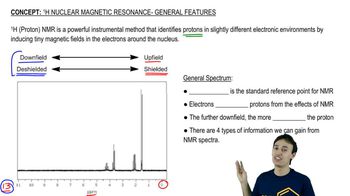
General NMR Features

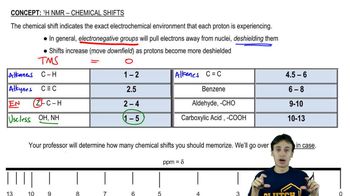
Chemical Shifts

Chemical shifts in NMR spectroscopy refer to the position of peaks in the spectrum, measured in parts per million (ppm). They indicate the electronic environment surrounding the hydrogen atoms in a molecule. For example, protons attached to sp2 hybridized carbons, such as those in alkenes, typically resonate downfield (higher ppm values), often around 5-7 ppm, as seen in the spectrum of trans-hex-2-enoic acid.
Video consigliato:
11:44
1H NMR Chemical Shifts

Spin-Spin Coupling

Spin-spin coupling, or J-coupling, occurs when neighboring hydrogen atoms influence each other's magnetic environments, leading to splitting of NMR signals. The number of peaks observed (multiplicity) is determined by the number of adjacent protons, following the n+1 rule, where n is the number of neighboring protons. This concept is crucial for interpreting the complex splitting patterns in the vinyl region of the spectrum, as seen in the peaks around 7 ppm.
Video consigliato:
02:54
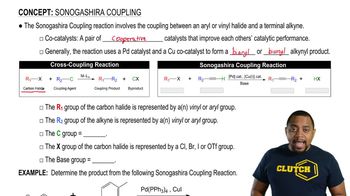
Sonogashira Coupling Reaction