Ch. 15 - Conjugated Systems, Orbital Symmetry, and Ultraviolet Spectroscopy
Wade - Organic Chemistry 9th Edition
Wade9th EditionOrganic ChemistryISBN: 9780135213728Non è quello che usi tu?Cambia libro di testo
Capitolo 15, Problema 36d

Show that the [6 + 2] cyclization of hexa-1,3,5-triene with maleic anhydride is thermally forbidden but photochemically allowed.
Structural formulas of hexa-1,3,5-triene and maleic anhydride with labels beneath each compound.

Guida verificata passo dopo passo
1
Step 1: Understand the reaction type. The [6 + 2] cyclization involves a pericyclic reaction where hexa-1,3,5-triene (a conjugated triene) reacts with maleic anhydride (a dienophile) to form a cyclic product. This reaction can proceed thermally or photochemically, depending on the electronic configuration of the reactants.
Step 2: Apply the Woodward-Hoffmann rules for pericyclic reactions. These rules state that the symmetry of molecular orbitals determines whether a reaction is thermally allowed or forbidden. For a [6 + 2] cyclization, analyze the symmetry of the π molecular orbitals in hexa-1,3,5-triene and maleic anhydride.
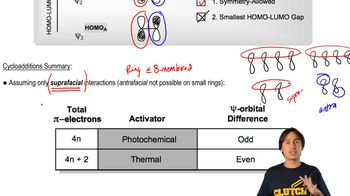
Step 3: Analyze the thermal reaction. In the ground state (thermal conditions), the π molecular orbitals of hexa-1,3,5-triene and maleic anhydride must interact constructively. However, the [6 + 2] cyclization requires an antarafacial interaction (opposite faces of the π system), which is symmetry-forbidden under thermal conditions.
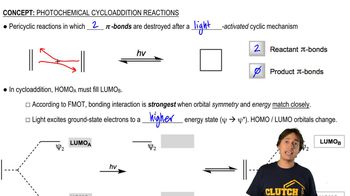
Step 4: Analyze the photochemical reaction. Under photochemical conditions, light excites the π electrons of hexa-1,3,5-triene to a higher energy state. This changes the symmetry of the molecular orbitals, allowing a suprafacial interaction (same face of the π system) with maleic anhydride. Thus, the reaction becomes symmetry-allowed photochemically.
Step 5: Conclude the analysis. Based on the Woodward-Hoffmann rules, the [6 + 2] cyclization of hexa-1,3,5-triene with maleic anhydride is thermally forbidden due to symmetry constraints but photochemically allowed due to the altered orbital symmetry in the excited state.

Risposta video verificata per un problema simile:

Questa soluzione video è stata consigliata dai nostri tutor come utile per risolvere questo problema.
Durata del video:
7m

Concetti chiave

Ecco i concetti essenziali che devi comprendere per rispondere correttamente alla domanda.

Cycloaddition Reactions

Cycloaddition reactions involve the formation of a cyclic compound from two or more reactants. In the case of [6 + 2] cyclization, a six-membered and a two-membered component combine to form an eight-membered ring. Understanding the mechanism and stereochemistry of these reactions is crucial for predicting their feasibility under different conditions.
Video consigliato:
08:29
Cycloadditions Summary Chart

Thermal vs. Photochemical Reactions

Thermal reactions occur at elevated temperatures and typically involve the breaking and forming of bonds through heat energy. In contrast, photochemical reactions are driven by light energy, allowing certain reactions to proceed that would be otherwise forbidden thermally due to energy barriers. This distinction is key in understanding why the cyclization of hexa-1,3,5-triene with maleic anhydride is thermally forbidden but photochemically allowed.
Video consigliato:
09:36
MO Theory of Photochemical Cycloadditions

Orbital Symmetry and Woodward-Hoffmann Rules

The Woodward-Hoffmann rules provide a framework for predicting the outcomes of pericyclic reactions based on the symmetry of molecular orbitals. In the case of the [6 + 2] cyclization, the conservation of orbital symmetry dictates that the reaction cannot proceed under thermal conditions due to symmetry mismatch, while it can proceed under photochemical conditions where the symmetry can be altered by light absorption.
Video consigliato:
Percorso guidato
1:18
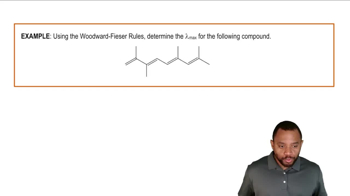
Woodward-Fieser Rules Example 1