
Ch. 15 - Conjugated Systems, Orbital Symmetry, and Ultraviolet Spectroscopy
Wade - Organic Chemistry 9th Edition
Wade9th EditionOrganic ChemistryISBN: 9780135213728Non è quello che usi tu?Cambia libro di testo
Capitolo 15, Problema 27e,f

Draw the important resonance contributors for the following cations, anions, and radicals.
(e) Chemical structure of a conjugated system featuring a carbonyl group, with adjacent double bonds and a -CH2 group.
(f) Chemical structure of a conjugated system showing resonance contributors for cations, anions, and radicals.

Guida verificata passo dopo passo
1
Step 1: Identify the resonance contributors by analyzing the structure. For the first molecule (e), the negative charge on the CH2 group can delocalize through the conjugated π-system. This involves the movement of electrons along the double bonds and towards the carbonyl group.
Step 2: Draw the first resonance structure for molecule (e) by moving the lone pair of electrons from the negatively charged CH2 group to form a double bond with the adjacent carbon. This will push the electrons in the existing double bond towards the next carbon in the chain.
Step 3: Continue the electron movement for molecule (e) by shifting the electrons in the conjugated π-system further down the chain, eventually reaching the carbonyl group. The oxygen in the carbonyl group can accept the electrons, forming a resonance structure with a negative charge on the oxygen.
Step 4: For the second molecule (f), analyze the aromatic ring and the carboxylate group. The negative charge on the oxygen can delocalize into the aromatic ring, forming resonance structures. This involves the movement of electrons from the oxygen into the ring, creating alternating double bonds and redistributing the negative charge.
Step 5: Draw additional resonance structures for molecule (f) by moving the electrons around the aromatic ring. Ensure that the negative charge is delocalized across the ring and that the aromaticity of the ring is preserved in all resonance contributors.

Risposta video verificata per un problema simile:

Questa soluzione video è stata consigliata dai nostri tutor come utile per risolvere questo problema.
Durata del video:
6m

Concetti chiave

Ecco i concetti essenziali che devi comprendere per rispondere correttamente alla domanda.

Resonance Structures

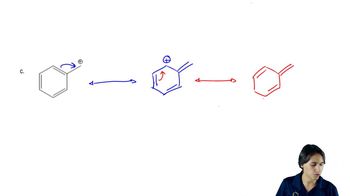
Resonance structures are different Lewis structures for the same molecule that depict the same arrangement of atoms but differ in the placement of electrons. These structures help illustrate the delocalization of electrons within a molecule, which can stabilize cations, anions, and radicals. Understanding resonance is crucial for predicting the reactivity and stability of these species.
Video consigliato:
03:04
Drawing Resonance Structures

Stability of Resonance Contributors

Not all resonance structures contribute equally to the overall resonance hybrid; some are more stable than others. Factors influencing stability include the octet rule, charge distribution, and the presence of formal charges. More stable resonance contributors have full octets, minimized formal charges, and charge separation that aligns with electronegativity trends.
Video consigliato:
03:43
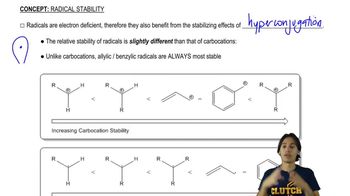
The radical stability trend.

Electrophiles and Nucleophiles

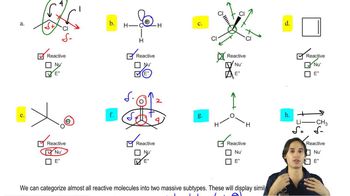
In organic chemistry, electrophiles are electron-deficient species that seek electrons, while nucleophiles are electron-rich species that donate electrons. Understanding the nature of these species is essential when analyzing resonance structures, as it helps predict how cations, anions, and radicals will interact in chemical reactions. This knowledge is fundamental for grasping reaction mechanisms and stability.
Video consigliato:
03:
Nucleophile or Electrophile
Pratica correlata
Domanda del libro di testo

A solution was prepared using 0.0010 g of an unknown steroid (of molecular weight around 255) in 100 mL of ethanol. Some of this solution was placed in a 1-cm cell, and the UV spectrum was measured. This solution was found to have λmax = 235 nm, with A = 0.74.

(a) Compute the value of the molar absorptivity at 235 nm.

(b) Which of the following compounds might give this spectrum?

1057
views
Domanda del libro di testo

Draw the important resonance contributors for the following cations, anions, and radicals.

(b)

1090
views
Domanda del libro di testo

Draw the important resonance contributors for the following cations, anions, and radicals.

(c)

1024
views
Domanda del libro di testo

The diene lactone shown in part (a) has one electron-donating group (-OR) and one electron-withdrawing group (C=O). This diene lactone is sufficiently electron-rich to serve as the diene in a Diels–Alder reaction.


b. The Diels–Alder product A is not very stable. Upon mild heating, it reacts to produce CO2 gas and methyl benzoate (PhCOOCH3), a very stable product. Explain how this strongly exothermic decarboxylation takes place. (Hint: Under the right conditions, the Diels–Alder reaction can be reversible.)

920
views
Domanda del libro di testo

Draw the important resonance contributors for the following cations, anions, and radicals.

(d)

1036
views
Domanda del libro di testo

Predict the products of the following proposed Diels–Alder reactions. Include stereochemistry where appropriate.

(a)

1212
views