Ch. 15 - Conjugated Systems, Orbital Symmetry, and Ultraviolet Spectroscopy
Wade - Organic Chemistry 9th Edition
Wade9th EditionOrganic ChemistryISBN: 9780135213728Non è quello che usi tu?Cambia libro di testo
Capitolo 15, Problema 31a,b,c

Predict the products of the following proposed Diels–Alder reactions. Include stereochemistry where appropriate.
(a) Chemical structure diagram showing a benzene ring reacting with a diene to form bridged products.
(b) Chemical structures of reactants in a Diels-Alder reaction, with an arrow indicating the formation of products.
(c) Chemical structures of a benzene ring and a diene, indicating a Diels-Alder reaction with a product arrow.

Guida verificata passo dopo passo
1
Identify the diene and dienophile in each reaction. The diene is the compound with two conjugated double bonds, and the dienophile is the compound with a double or triple bond that will react with the diene.
For reaction (a), the diene is the 1,3-butadiene, and the dienophile is the acrolein (propenal). The Diels-Alder reaction will form a six-membered ring by joining the diene and dienophile.
For reaction (b), the diene is the benzene ring, and the dienophile is the methyl propiolate. The Diels-Alder reaction will form a six-membered ring, and the stereochemistry of the product will depend on the orientation of the substituents on the dienophile.
For reaction (c), the diene is furan, and the dienophile is methyl vinyl ketone. The Diels-Alder reaction will form a six-membered ring, and the stereochemistry will be influenced by the electron-withdrawing group on the dienophile.
Consider the stereochemistry of the products. In Diels-Alder reactions, the endo product is usually favored due to secondary orbital interactions. This means that substituents on the dienophile will typically end up on the same side of the newly formed ring as the largest substituents on the diene.

Risposta video verificata per un problema simile:

Questa soluzione video è stata consigliata dai nostri tutor come utile per risolvere questo problema.
Durata del video:
8m

Concetti chiave

Ecco i concetti essenziali che devi comprendere per rispondere correttamente alla domanda.

Diels–Alder Reaction

The Diels–Alder reaction is a [4+2] cycloaddition reaction between a conjugated diene and a dienophile, resulting in the formation of a six-membered ring. This reaction is a key method in organic synthesis for constructing cyclic compounds and is characterized by its stereospecificity, meaning the stereochemistry of the reactants directly influences the stereochemistry of the products.
Video consigliato:
04:02
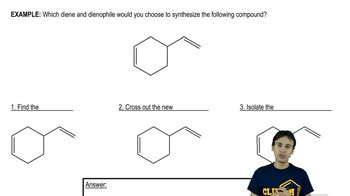
Diels-Alder Retrosynthesis

Stereochemistry

Stereochemistry refers to the study of the spatial arrangement of atoms in molecules and how this affects their chemical behavior. In the context of Diels–Alder reactions, understanding stereochemistry is crucial for predicting the configuration of the product, as the reaction can lead to the formation of chiral centers and specific stereoisomers depending on the orientation of the diene and dienophile.
Video consigliato:
Percorso guidato
1:38
Polymer Stereochemistry Concept 1

Electron Density and Reactivity

The reactivity of the diene and dienophile in a Diels–Alder reaction is influenced by their electron density. Dienes are typically electron-rich, while dienophiles can be electron-poor, often containing electron-withdrawing groups. This difference in electron density facilitates the formation of new sigma bonds during the reaction, making it essential to analyze the substituents on both reactants to predict the reaction outcome.
Video consigliato:
07:07
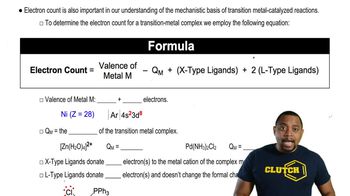
Electron Counting