Ch. 15 - Conjugated Systems, Orbital Symmetry, and Ultraviolet Spectroscopy
Wade - Organic Chemistry 9th Edition
Wade9th EditionOrganic ChemistryISBN: 9780135213728Non è quello che usi tu?Cambia libro di testo
Capitolo 15, Problema 26c

Show how the reaction of an allylic halide with a Grignard reagent might be used to synthesize the following hydrocarbons.
c. 1-cyclopentylpent-2-ene

Guida verificata passo dopo passo
1
Step 1: Understand the reaction mechanism. The reaction involves the use of an allylic halide and a Grignard reagent to form a new carbon-carbon bond. Grignard reagents are organomagnesium compounds (R-MgX) that act as nucleophiles, attacking electrophilic centers such as carbon atoms in halides.
Step 2: Identify the allylic halide and Grignard reagent needed for the synthesis. To form 1-cyclopentylpent-2-ene, the allylic halide should have the structure CH₂=CH-CH₂-X (where X is a halogen, such as Br or Cl), and the Grignard reagent should be cyclopentylmagnesium bromide (C₅H₉-MgBr).
Step 3: Write the reaction mechanism. The Grignard reagent attacks the allylic halide at the electrophilic carbon attached to the halogen, replacing the halogen with the cyclopentyl group. This forms the desired hydrocarbon. The general reaction can be represented as: CH2=CH-CH2X+C5H-MgBr→CH2=CH-CH2C5H
Step 4: Consider stereochemistry and regioselectivity. Since the allylic halide is symmetrical, the reaction proceeds without regioselectivity concerns. The product will retain the double bond in the same position as the starting material.
Step 5: Verify the structure of the product. The final product, 1-cyclopentylpent-2-ene, has the structure CH₂=CH-CH₂-C₅H₉. Ensure that the double bond remains intact and the cyclopentyl group is correctly attached to the allylic position.

Risposta video verificata per un problema simile:

Questa soluzione video è stata consigliata dai nostri tutor come utile per risolvere questo problema.
Durata del video:
3m

Concetti chiave

Ecco i concetti essenziali che devi comprendere per rispondere correttamente alla domanda.

Allylic Halides

Allylic halides are organic compounds where a halogen atom is bonded to an allylic carbon, which is adjacent to a carbon-carbon double bond. This positioning makes them reactive in nucleophilic substitution reactions, allowing for the formation of new carbon-carbon bonds. Understanding the structure and reactivity of allylic halides is crucial for predicting the outcomes of reactions with nucleophiles like Grignard reagents.
Video consigliato:
01:52
How to name alkyl halides

Grignard Reagents

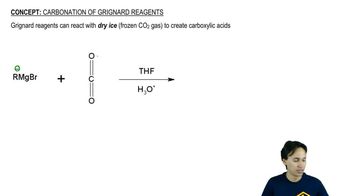
Grignard reagents are organomagnesium compounds represented as R-MgX, where R is an organic group and X is a halogen. They are powerful nucleophiles that can react with electrophiles to form new carbon-carbon bonds. In the context of synthesizing hydrocarbons, Grignard reagents can add to carbonyl compounds or react with allylic halides to create larger, more complex molecules.
Video consigliato:
02:12
Carbonation of Grignard Reagents

Synthesis of Alkenes

The synthesis of alkenes often involves the formation of double bonds through elimination reactions or the addition of nucleophiles to unsaturated systems. In this case, the reaction of an allylic halide with a Grignard reagent can lead to the formation of a new carbon chain, which can subsequently undergo elimination to yield the desired alkene, such as 1-cyclopentylpent-2-ene. Understanding the mechanisms of these reactions is essential for successful synthesis.
Video consigliato:
Percorso guidato
1:47
Alkene Metathesis Concept 2