

Ch. 15 - Conjugated Systems, Orbital Symmetry, and Ultraviolet Spectroscopy
Wade - Organic Chemistry 9th Edition
Wade9th EditionOrganic ChemistryISBN: 9780135213728Non è quello che usi tu?Cambia libro di testo
Capitolo 15, Problema 37g

The pentadienyl radical, H2C=CH–CH=CH–CH2•, has its unpaired electron delocalized over three carbon atoms.
g. Remove the highest-energy electron from the pentadienyl radical to give the pentadienyl cation. Which carbon atoms share the positive charge? Does this picture agree with the resonance picture?

Guida verificata passo dopo passo
1
Step 1: Understand the structure of the pentadienyl radical. It consists of a conjugated system with alternating double and single bonds: H₂C=CH-CH=CH-CH₂·. The unpaired electron is delocalized over the three central carbon atoms (C2, C3, and C4) due to resonance.
Step 2: Removing the highest-energy electron from the pentadienyl radical results in the formation of the pentadienyl cation. This means the unpaired electron is removed, leaving a positive charge that will also be delocalized over the conjugated system.
Step 3: Draw the resonance structures of the pentadienyl cation. The positive charge will be shared among the three central carbon atoms (C2, C3, and C4) due to the delocalization of π-electrons in the conjugated system. Use curved arrows to show the movement of electrons in each resonance structure.
Step 4: Analyze the resonance structures to confirm that the positive charge is distributed over C2, C3, and C4. This delocalization stabilizes the cation and agrees with the resonance picture of the pentadienyl radical, where the unpaired electron was also delocalized over the same three carbon atoms.
Step 5: Conclude that the positive charge in the pentadienyl cation is shared among C2, C3, and C4, and this distribution is consistent with the resonance picture of the original pentadienyl radical. This demonstrates the importance of resonance in stabilizing both radicals and cations in conjugated systems.

Risposta video verificata per un problema simile:

Questa soluzione video è stata consigliata dai nostri tutor come utile per risolvere questo problema.
Durata del video:
14m

Concetti chiave

Ecco i concetti essenziali che devi comprendere per rispondere correttamente alla domanda.

Radicals and Cations

Radicals are species that contain an unpaired electron, making them highly reactive. In contrast, cations are positively charged species formed when an electron is removed from a neutral atom or molecule. In the case of the pentadienyl radical, removing the highest-energy electron results in a pentadienyl cation, which has a positive charge that can be delocalized over adjacent carbon atoms.
Video consigliato:
Percorso guidato
0:52
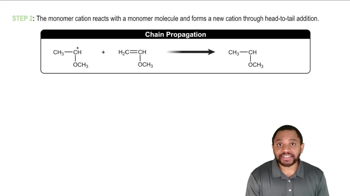
Cationic Polymerization Concept 3

Delocalization of Charge

Delocalization refers to the spreading of electrons or charge over multiple atoms rather than being localized on a single atom. In the pentadienyl cation, the positive charge can be shared among the carbon atoms involved in the double bonds, which stabilizes the cation. This delocalization is a key factor in understanding the stability and reactivity of the cation.
Video consigliato:
01:34
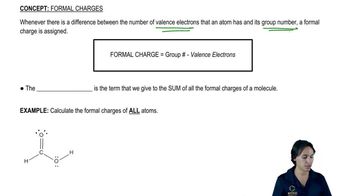
Calculating formal and net charge.

Resonance Structures

Resonance structures are different ways of drawing a molecule that represent the same arrangement of atoms but differ in the placement of electrons. For the pentadienyl cation, resonance structures illustrate how the positive charge can be distributed across different carbon atoms. This concept helps explain the stability of the cation, as the actual structure is a hybrid of these resonance forms.
Video consigliato:
03:04
Drawing Resonance Structures
Pratica correlata
Domanda del libro di testo

The pentadienyl radical, H2C=CH–CH=CH–CH2•, has its unpaired electron delocalized over three carbon atoms.

h. Add an electron to the pentadienyl radical to give the pentadienyl anion. Which carbon atoms share the negative charge? Does this picture agree with the resonance picture?

1145
views
Domanda del libro di testo

A student was studying terpene synthesis, and she wanted to make the compound shown here. First she converted 3-bromo-6-methylcyclohexene to alcohol A. She heated alcohol A with sulfuric acid and purified one of the components (compound B) from the resulting mixture. Compound B has the correct molecular formula for the desired product.

a. Suggest how 3-bromo-6-methylcyclohexene might be converted to alcohol A.

530
views
Domanda del libro di testo

The pentadienyl radical, H2C=CH–CH=CH–CH2•, has its unpaired electron delocalized over three carbon atoms.

b. How many MOs are there in the molecular orbital picture of the pentadienyl radical?

c. How many nodes are there in the lowest-energy MO of the pentadienyl system? How many in the highest-energy MO?

d. Draw the MOs of the pentadienyl system in order of increasing energy

948
views
Domanda del libro di testo

A student was studying terpene synthesis, and she wanted to make the compound shown here. First she converted 3-bromo-6-methylcyclohexene to alcohol A. She heated alcohol A with sulfuric acid and purified one of the components (compound B) from the resulting mixture. Compound B has the correct molecular formula for the desired product.

(c) Propose a mechanism for the dehydration of alcohol A to compound B.

1469
views
Domanda del libro di testo

The pentadienyl radical, H2C=CH–CH=CH–CH2•, has its unpaired electron delocalized over three carbon atoms.

f. Show how your molecular orbital picture agrees with the resonance picture showing delocalization of the unpaired electron onto three carbon atoms.

955
views
Domanda del libro di testo

The pentadienyl radical, H2C=CH–CH=CH–CH2•, has its unpaired electron delocalized over three carbon atoms.

a. Use resonance forms to show which three carbon atoms bear the unpaired electron.

823
views