


Ch. 16 - Aromatic Compounds
Wade - Organic Chemistry 9th Edition
Wade9th EditionOrganic ChemistryISBN: 9780135213728Non è quello che usi tu?Cambia libro di testo
Capitolo 16, Problema 30

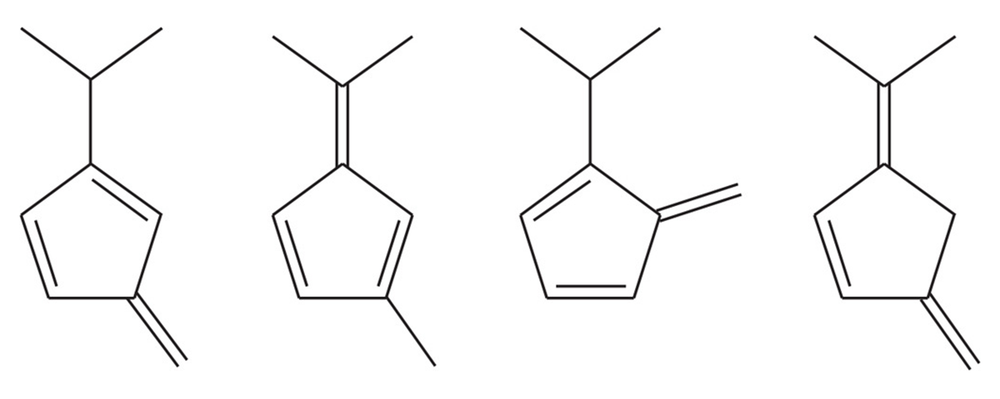
One of the following hydrocarbons is much more acidic than the others. Indicate which one, and explain why it is unusually acidic.

Guida verificata passo dopo passo
1
Step 1: Analyze the structures of the hydrocarbons provided in the image. Each structure contains a five-membered ring with varying substituents. Pay attention to the presence of double bonds and the type of substituents attached to the ring.
Step 2: Recall that acidity in hydrocarbons is influenced by the stability of the conjugate base formed after deprotonation. A more stable conjugate base corresponds to a more acidic compound.
Step 3: Examine the substituents on the ring. In structure C, the substituent is an electron-withdrawing carbonyl group (C=O). Electron-withdrawing groups stabilize the negative charge on the conjugate base through resonance or inductive effects.
Step 4: Compare the other structures (A, B, and D). These structures lack electron-withdrawing groups like the carbonyl group in C. Their conjugate bases are less stabilized, making them less acidic.
Step 5: Conclude that structure C is unusually acidic due to the presence of the carbonyl group, which stabilizes the conjugate base through resonance and inductive effects, making it much more acidic than the other hydrocarbons.

Risposta video verificata per un problema simile:

Questa soluzione video è stata consigliata dai nostri tutor come utile per risolvere questo problema.
Durata del video:
11m

Concetti chiave

Ecco i concetti essenziali che devi comprendere per rispondere correttamente alla domanda.

Acidity of Hydrocarbons

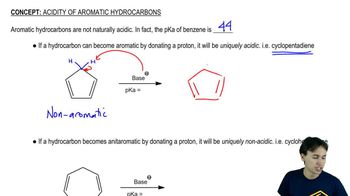
The acidity of hydrocarbons is determined by their ability to donate protons (H+ ions). In organic chemistry, the presence of electronegative atoms or groups can stabilize the negative charge of the conjugate base formed after deprotonation, thus increasing acidity. Aromatic compounds often exhibit unique acidity due to resonance stabilization.
Video consigliato:
05:39
Aromatic hydrocarbon acidity

Resonance Stabilization

Resonance stabilization occurs when a molecule can be represented by multiple valid Lewis structures, allowing for the delocalization of electrons. This delocalization can stabilize the negative charge on a conjugate base, making the corresponding acid more acidic. In aromatic compounds, resonance can significantly influence acidity by distributing charge over the aromatic system.
Video consigliato:
03:43
The radical stability trend.

Aromaticity

Aromaticity refers to the enhanced stability of cyclic compounds with conjugated pi electron systems that follow Huckel's rule (4n + 2 pi electrons). Aromatic compounds are often more stable than their non-aromatic counterparts, which can affect their reactivity and acidity. The unique electronic structure of aromatic compounds can lead to unusual acidity patterns among different hydrocarbons.
Video consigliato:
08:19
Intro to Aromaticity
Pratica correlata
Domanda del libro di testo

The following molecules and ions are grouped by similar structures. Classify each as aromatic, antiaromatic, or nonaromatic. For the aromatic and antiaromatic species, give the number of pi electrons in the ring.

(a)

671
views
Domanda del libro di testo

Four pairs of compounds are shown. In each pair, one of the compounds reacts more quickly, or with a more favorable equilibrium constant, than the less conjugated system. In each case, explain the enhanced reactivity.

(d)

865
views
Domanda del libro di testo

The following molecules and ions are grouped by similar structures. Classify each as aromatic, antiaromatic, or nonaromatic. For the aromatic and antiaromatic species, give the number of pi electrons in the ring.

(c)

626
views
Domanda del libro di testo

The following molecules and ions are grouped by similar structures. Classify each as aromatic, antiaromatic, or nonaromatic. For the aromatic and antiaromatic species, give the number of pi electrons in the ring.

(b)

575
views
Domanda del libro di testo

Four pairs of compounds are shown. In each pair, one of the compounds reacts more quickly, or with a more favorable equilibrium constant, than the less conjugated system. In each case, explain the enhanced reactivity.

(a)

(b)

635
views
Domanda del libro di testo

Four pairs of compounds are shown. In each pair, one of the compounds reacts more quickly, or with a more favorable equilibrium constant, than the less conjugated system. In each case, explain the enhanced reactivity.

(c)

990
views