Make a model of cyclooctatetraene in the tub conformation. Draw this conformation, and estimate the angle between the p orbitals of adjacent pi bonds.
Ch. 16 - Aromatic Compounds
Capitolo 16, Problema 4
Show the product of the Diels–Alder dimerization of cyclobutadiene. (This reaction is similar to the dimerization of cyclopentadiene, discussed in Section 15-11.)
Guida verificata passo dopo passo1
Identify the reactants: Cyclobutadiene is the diene in this reaction. It is a highly reactive compound due to its antiaromaticity (4π electrons). The Diels–Alder reaction involves a diene and a dienophile, but in this case, cyclobutadiene acts as both the diene and the dienophile.
Analyze the reaction mechanism: The Diels–Alder reaction is a [4+2] cycloaddition, where four π-electrons from the diene interact with two π-electrons from the dienophile to form a new six-membered ring. Cyclobutadiene will react with another molecule of itself to form a dimer.
Draw the interaction: Orient one molecule of cyclobutadiene as the diene (with conjugated double bonds) and the other as the dienophile (with one double bond acting as the π-system). The π-electrons from the diene will overlap with the π-electrons of the dienophile.
Predict the product: The reaction will result in the formation of a bicyclic compound. Specifically, the product will be a bicyclo[2.2.0]hexadiene structure, where the two cyclobutadiene units are fused together to form a six-membered ring with two double bonds.
Verify stereochemistry and stability: Since cyclobutadiene is highly reactive and unstable, the dimerization helps relieve some of the antiaromaticity. Ensure that the product structure is consistent with the rules of the Diels–Alder reaction and that all bonds are correctly formed.

Risposta video verificata per un problema simile:
Questa soluzione video è stata consigliata dai nostri tutor come utile per risolvere questo problema.
Durata del video:
3mConcetti chiave
Ecco i concetti essenziali che devi comprendere per rispondere correttamente alla domanda.
Diels–Alder Reaction
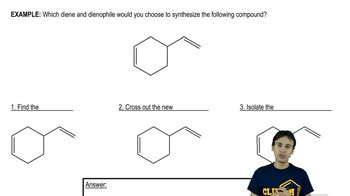
The Diels–Alder reaction is a [4+2] cycloaddition reaction between a conjugated diene and a dienophile, resulting in the formation of a six-membered ring. This reaction is characterized by its stereospecificity and is widely used in organic synthesis to create complex cyclic structures. Understanding the mechanism involves recognizing the roles of electron-rich and electron-poor species in the reaction.
Video consigliato:
Diels-Alder Retrosynthesis
Cyclobutadiene
Cyclobutadiene is a four-membered cyclic compound with alternating double bonds, making it a highly reactive diene. Due to its antiaromatic nature, it is unstable and tends to dimerize or undergo other reactions quickly. Its behavior in the Diels–Alder reaction is significant because it can act as a diene, leading to the formation of larger cyclic products.
Video consigliato:
Percorso guidato
The UV-Vis Spectroscopy Example 2
Dimerization
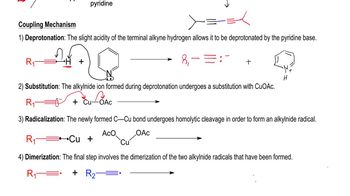
Dimerization refers to the process where two identical molecules combine to form a dimer, which is a larger compound. In the context of cyclobutadiene, dimerization can occur through the Diels–Alder reaction, resulting in a stable product from two reactive diene units. This concept is crucial for predicting the outcome of reactions involving unstable intermediates like cyclobutadiene.
Video consigliato:
Eglinton Reaction
Pratica correlata
Domanda del libro di testo
1299
views
Domanda del libro di testo
a. Draw the resonance forms of benzene, cyclobutadiene, and cyclooctatetraene, showing all the carbon and hydrogen atoms.
b. Assuming that these molecules are all planar, show how the p orbitals on the sp2 hybrid carbon atoms form continuous rings of overlapping orbitals above and below the plane of the carbon atoms.
1002
views
Domanda del libro di testo
Using the information in Figure 16-2, calculate the values of ∆H° for the following reactions:
(b)
578
views
Domanda del libro di testo
Classify the following compounds as aromatic, antiaromatic, or nonaromatic.
(a)
(b)
1090
views
Domanda del libro di testo
Does the MO energy diagram of cyclooctatetraene (Figure 16-8) appear to be a particularly stable or unstable configuration? Explain.
1970
views
1
rank
Domanda del libro di testo
Using the information in Figure 16-2, calculate the values of ∆H° for the following reactions:
(c)
605
views