Ch. 17 - Reactions of Aromatic Compounds
Wade - Organic Chemistry 9th Edition
Wade9th EditionOrganic ChemistryISBN: 9780135213728Non è quello che usi tu?Cambia libro di testo
Capitolo 17, Problema 54b

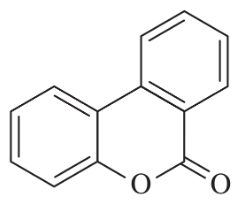
Predict the major products of bromination of the following compounds, using Br2 and FeBr3 in the dark.
(b)

Guida verificata passo dopo passo
1
Step 1: Analyze the structure of the compound in part (b). The compound is anthraquinone, which consists of two benzene rings fused to a quinone group. The quinone group contains two carbonyl groups, which are electron-withdrawing groups.
Step 2: Understand the reaction conditions. Bromination using Br2 and FeBr3 in the dark is an electrophilic aromatic substitution reaction. The FeBr3 acts as a Lewis acid catalyst, generating the bromonium ion (Br+) as the electrophile.
Step 3: Determine the directing effects of the substituents. The carbonyl groups in the quinone are strongly electron-withdrawing and deactivate the aromatic ring toward electrophilic substitution. They direct substitution to the meta positions relative to themselves.
Step 4: Identify the most reactive positions for bromination. The benzene rings adjacent to the quinone group are deactivated, but the meta positions relative to the carbonyl groups are the most likely sites for bromination due to the directing effects of the electron-withdrawing groups.
Step 5: Predict the major product. Bromination will occur at the meta positions relative to the carbonyl groups on the benzene rings. The product will have bromine atoms substituted at these positions.

Risposta video verificata per un problema simile:

Questa soluzione video è stata consigliata dai nostri tutor come utile per risolvere questo problema.
Durata del video:
5m

Concetti chiave

Ecco i concetti essenziali che devi comprendere per rispondere correttamente alla domanda.

Electrophilic Aromatic Substitution (EAS)

Electrophilic Aromatic Substitution is a fundamental reaction in organic chemistry where an electrophile replaces a hydrogen atom on an aromatic ring. In this process, the aromatic system donates electrons to the electrophile, forming a sigma complex, which then loses a proton to restore aromaticity. Understanding EAS is crucial for predicting the products of bromination, as it explains how bromine interacts with the aromatic compound.
Video consigliato:
03:07
EAS Review

Bromination Mechanism

Bromination of aromatic compounds typically involves the use of bromine (Br2) and a Lewis acid catalyst like FeBr3. The Lewis acid polarizes the Br-Br bond, generating a more reactive bromonium ion that can attack the aromatic ring. This mechanism is essential for predicting the major products, as it determines the regioselectivity of the substitution based on the stability of the intermediates formed.
Video consigliato:
00:54
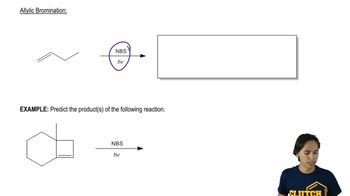
Mechanism of Allylic Bromination.

Regioselectivity in Substitution Reactions

Regioselectivity refers to the preference of a chemical reaction to yield one structural isomer over others when multiple possibilities exist. In the context of bromination, the presence of substituents on the aromatic ring can influence where the bromine atom will attach, favoring positions that lead to more stable intermediates. Recognizing the effects of substituents is vital for accurately predicting the major products of the reaction.
Video consigliato:
01:34
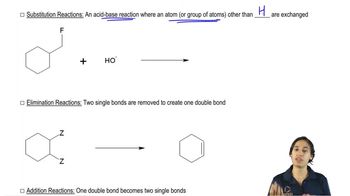
Recognizing Substitution Reactions.