Ch. 17 - Reactions of Aromatic Compounds
Wade - Organic Chemistry 9th Edition
Wade9th EditionOrganic ChemistryISBN: 9780135213728Non è quello che usi tu?Cambia libro di testo
Capitolo 17, Problema 33

Predict the major products of treating the following compounds with hot, concentrated potassium permanganate, followed by acidification with dilute HCl.
(a) isopropylbenzene
(b) p-xylene
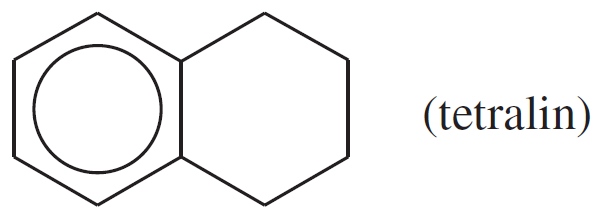
(c)

Guida verificata passo dopo passo
1
Step 1: Understand the reaction conditions. Hot, concentrated potassium permanganate (KMnO₄) is a strong oxidizing agent that oxidizes alkyl side chains on aromatic rings to carboxylic acids. Acidification with dilute HCl ensures the carboxylic acids are in their protonated form.
Step 2: Analyze compound (a), isopropylbenzene. The isopropyl group attached to the benzene ring will be oxidized by KMnO₄ to a carboxylic acid group, resulting in benzoic acid (C₆H₅COOH).
Step 3: Analyze compound (b), p-xylene. The two methyl groups on the benzene ring will each be oxidized to carboxylic acid groups, resulting in terephthalic acid (C₆H₄(COOH)₂).
Step 4: Analyze compound (c), tetralin. The alkyl side chain (cyclohexane ring fused to benzene) will be oxidized to a carboxylic acid group. The benzene ring remains intact, and the product will be 1,2-benzenedicarboxylic acid (phthalic acid).
Step 5: Confirm the major products. After oxidation and acidification, the major products are benzoic acid for (a), terephthalic acid for (b), and phthalic acid for (c). These products are consistent with the oxidative cleavage of alkyl side chains by KMnO₄.

Risposta video verificata per un problema simile:

Questa soluzione video è stata consigliata dai nostri tutor come utile per risolvere questo problema.
Durata del video:
7m

Concetti chiave

Ecco i concetti essenziali che devi comprendere per rispondere correttamente alla domanda.

Oxidation Reactions

Oxidation reactions in organic chemistry involve the loss of electrons or an increase in oxidation state, often resulting in the formation of carbonyl compounds or carboxylic acids. In the context of potassium permanganate, a strong oxidizing agent, it can cleave carbon-carbon bonds and oxidize alkyl groups attached to aromatic rings, leading to the formation of various products depending on the structure of the starting material.
Video consigliato:
03:20
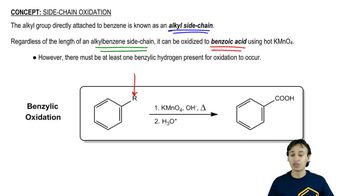
Benzylic Oxidation

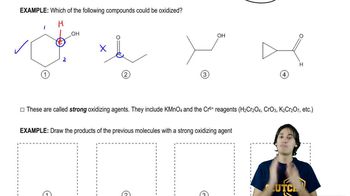
Potassium Permanganate (KMnO4) as an Oxidizing Agent

Potassium permanganate is a powerful oxidizing agent commonly used in organic synthesis. When heated and concentrated, it can oxidize aliphatic and aromatic compounds, converting alkyl side chains into carboxylic acids or ketones. The reaction conditions, such as temperature and concentration, significantly influence the extent of oxidation and the nature of the products formed.
Video consigliato:
03:40
Strong oxidizing agents

Acidification with Dilute HCl

After oxidation with potassium permanganate, acidification with dilute hydrochloric acid (HCl) is often performed to neutralize the reaction mixture and convert any intermediate products into their stable forms. This step can also help in the hydrolysis of any remaining permanganate species, ensuring that the final products are in their desired forms, such as carboxylic acids or phenols, which can be further analyzed or isolated.
Video consigliato:
04:06
Intro to Nucleophilic Acyl Substituion