Ch. 17 - Reactions of Aromatic Compounds
Wade - Organic Chemistry 9th Edition
Wade9th EditionOrganic ChemistryISBN: 9780135213728Non è quello che usi tu?Cambia libro di testo
Capitolo 17, Problema 30b

Show how you would use Suzuki reactions to synthesize these products from the indicated starting materials. You may use any additional reagents you need.
(b) Chemical reaction diagram illustrating the synthesis of a product from a brominated starting material using Suzuki reaction.

Guida verificata passo dopo passo
1
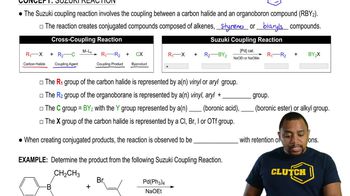
Step 1: Identify the Suzuki reaction components. The Suzuki reaction involves coupling an aryl or vinyl halide (in this case, the brominated compound) with an organoboron compound in the presence of a palladium catalyst and a base.
Step 2: Determine the organoboron compound needed. To extend the chain and introduce the alkyl group, you need an alkylboronic acid or alkylboronate ester that matches the desired product's structure (e.g., a butylboronic acid or butylboronate).
Step 3: Set up the reaction conditions. Combine the brominated starting material, the organoboron compound, a palladium catalyst (e.g., Pd(PPh₃)₄), and a base (e.g., K₂CO₃ or NaOH) in a suitable solvent like tetrahydrofuran (THF) or water.
Step 4: Perform the Suzuki coupling reaction. Under the reaction conditions, the palladium catalyst facilitates the formation of a new carbon-carbon bond between the brominated compound and the alkyl group from the organoboron reagent.
Step 5: Purify the product. After the reaction is complete, isolate the desired product using techniques such as extraction, chromatography, or recrystallization to obtain the final compound with the extended alkyl chain.

Risposta video verificata per un problema simile:

Questa soluzione video è stata consigliata dai nostri tutor come utile per risolvere questo problema.
Durata del video:
2m

Concetti chiave

Ecco i concetti essenziali che devi comprendere per rispondere correttamente alla domanda.

Suzuki Coupling Reaction

The Suzuki coupling reaction is a powerful method for forming carbon-carbon bonds, particularly between aryl or vinyl halides and organoboron compounds. This reaction typically requires a palladium catalyst and a base, allowing for the coupling of two organic fragments to create more complex molecules. It is widely used in organic synthesis for constructing biaryl compounds and other complex structures.
Video consigliato:
04:02
Suzuki Reaction

Organoboron Compounds

Organoboron compounds, such as boronic acids and boronate esters, are key reagents in the Suzuki reaction. They contain a boron atom bonded to a carbon atom, which can participate in nucleophilic attack during the coupling process. Their stability and reactivity make them ideal for forming new carbon-carbon bonds, facilitating the synthesis of diverse organic molecules.
Video consigliato:
01:40
Defining meso compounds.

Reaction Conditions

The success of the Suzuki reaction depends on specific reaction conditions, including the choice of solvent, temperature, and the presence of a base. Common solvents include water, ethanol, or toluene, while bases like sodium carbonate or potassium phosphate are often used to deprotonate the organoboron compound. Optimizing these conditions is crucial for achieving high yields and selectivity in the desired product.
Video consigliato:
Percorso guidato
1:18
EAS Reactions of Pyridine Example 1