

Ch. 17 - Reactions of Aromatic Compounds
Wade - Organic Chemistry 9th Edition
Wade9th EditionOrganic ChemistryISBN: 9780135213728Non è quello che usi tu?Cambia libro di testo
Capitolo 17, Problema 67a,b

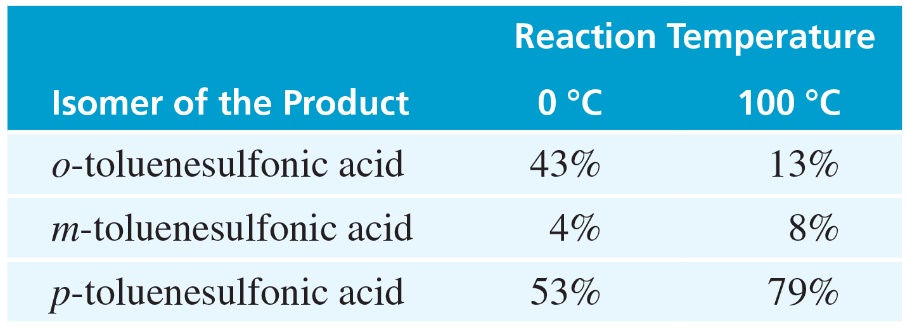
Unlike most other electrophilic aromatic substitutions, sulfonation is often reversible (see Section 17-4). When one sample of toluene is sulfonated at 0 °C and another sample is sulfonated at 100 °C, the following ratios of substitution products result:

a. Explain the change in the product ratios when the temperature is increased.
b. Predict what will happen when the product mixture from the reaction at 0 °C is heated to 100 °C.

Guida verificata passo dopo passo
1
Step 1: Analyze the data provided in the table. At 0 °C, the major product is p-toluenesulfonic acid (53%), followed by o-toluenesulfonic acid (43%), and m-toluenesulfonic acid (4%). At 100 °C, the major product is still p-toluenesulfonic acid (79%), but the proportion of o-toluenesulfonic acid decreases significantly (13%), while m-toluenesulfonic acid increases slightly (8%).
Step 2: Recall the concept of kinetic versus thermodynamic control in chemical reactions. At lower temperatures (0 °C), the reaction is under kinetic control, favoring the formation of products that form faster (o- and p-isomers due to steric and electronic effects). At higher temperatures (100 °C), the reaction is under thermodynamic control, favoring the most stable product (p-isomer due to steric hindrance and resonance stabilization).
Step 3: Explain the reversibility of sulfonation. Sulfonation reactions are reversible, meaning that at higher temperatures, the initially formed kinetic products (o- and p-isomers) can revert to the starting material and re-form, favoring the thermodynamic product (p-isomer).
Step 4: Predict the outcome when the product mixture from 0 °C is heated to 100 °C. Heating the mixture will allow the reaction to reach thermodynamic equilibrium, increasing the proportion of the thermodynamically favored p-toluenesulfonic acid while decreasing the proportion of o-toluenesulfonic acid. The m-isomer may also increase slightly due to its stability under thermodynamic conditions.
Step 5: Summarize the reasoning. The change in product ratios with temperature is due to the shift from kinetic control at 0 °C to thermodynamic control at 100 °C. Heating the 0 °C product mixture to 100 °C will favor the formation of the thermodynamic product (p-toluenesulfonic acid), aligning the product distribution with the ratios observed at 100 °C.

Risposta video verificata per un problema simile:

Questa soluzione video è stata consigliata dai nostri tutor come utile per risolvere questo problema.
Durata del video:
4m

Concetti chiave

Ecco i concetti essenziali che devi comprendere per rispondere correttamente alla domanda.

Electrophilic Aromatic Substitution (EAS)

Electrophilic Aromatic Substitution is a fundamental reaction in organic chemistry where an electrophile replaces a hydrogen atom on an aromatic ring. The reaction typically involves the formation of a sigma complex, followed by deprotonation to restore aromaticity. Understanding EAS is crucial for analyzing how different substituents affect the reactivity and orientation of aromatic compounds during sulfonation.
Video consigliato:
03:07
EAS Review

Temperature Effects on Reaction Equilibrium

The temperature of a reaction can significantly influence the equilibrium position, particularly in reversible reactions like sulfonation. According to Le Chatelier's principle, increasing temperature favors the endothermic direction of a reaction. In this case, higher temperatures promote the formation of the more stable p-toluenesulfonic acid, leading to a shift in product ratios as observed in the data.
Video consigliato:
04:00
Determining Acid/Base Equilibrium

Isomer Stability and Product Distribution

The stability of isomers plays a critical role in determining the distribution of products in a chemical reaction. In the case of toluenesulfonic acids, the para isomer (p-toluenesulfonic acid) is generally more stable due to less steric hindrance and greater resonance stabilization compared to the ortho and meta isomers. This stability influences the product ratios at different temperatures, as seen in the provided data.
Video consigliato:
01:10
What is a constitutional isomer?
Pratica correlata
Domanda del libro di testo

Furan undergoes electrophilic aromatic substitution more readily than benzene; mild reagents and conditions are sufficient. For example, furan reacts with bromine to give 2-bromofuran.

a. Propose mechanisms for the bromination of furan at the 2-position and at the 3-position. Draw the resonance forms of each sigma complex, and compare their stabilities.

3491
views
Domanda del libro di testo

Furan undergoes electrophilic aromatic substitution more readily than benzene; mild reagents and conditions are sufficient. For example, furan reacts with bromine to give 2-bromofuran.

b. Explain why furan undergoes bromination (and other electrophilic aromatic substitutions) primarily at the 2-position.

3507
views
Domanda del libro di testo

In Chapter 14, we saw that Agent Orange contains (2,4,5-trichlorophenoxy) acetic acid, called 2,4,5-T. This compound is synthesized by the partial reaction of 1,2,4,5-tetrachlorobenzene with sodium hydroxide, followed by reaction with sodium chloroacetate, ClCH2CO2Na.

a. Draw the structures of these compounds, and write equations for these reactions.

776
views
Domanda del libro di testo

Phenol reacts with three equivalents of bromine in CCl4 (in the dark) to give a product of formula C6H3OBr3. When this product is added to bromine water, a yellow solid of molecular formula C6H2OBr4 precipitates out of the solution. The IR spectrum of the yellow precipitate shows a strong absorption (much like that of a quinone) around 1680 cm–1. Propose structures for the two products.

4536
views
Domanda del libro di testo

(a) Draw the three isomers of benzenedicarboxylic acid.

(b) The isomers have melting points of 210 °C, 343 °C, and 427 °C. Nitration of the isomers at all possible positions was once used to determine their structures. The isomer that melts at 210 °C gives two mononitro isomers. The isomer that melts at 343 °C gives three mononitro isomers. The isomer that melts at 427 °C gives only one mononitro isomer. Show which isomer has which melting point.

1338
views
Domanda del libro di testo

Unlike most other electrophilic aromatic substitutions, sulfonation is often reversible (see Section 17-4). When one sample of toluene is sulfonated at 0 °C and another sample is sulfonated at 100 °C, the following ratios of substitution products result:

c. Because the SO3H group can be added to a benzene ring and removed later, it is sometimes called a blocking group. Show how 2,6-dibromotoluene can be made from toluene using sulfonation and desulfonation as intermediate steps in the synthesis.

1265
views