Ch. 18 - Ketones and Aldehydes
Wade - Organic Chemistry 9th Edition
Wade9th EditionOrganic ChemistryISBN: 9780135213728Non è quello che usi tu?Cambia libro di testo
Capitolo 18, Problema 19a,b,c

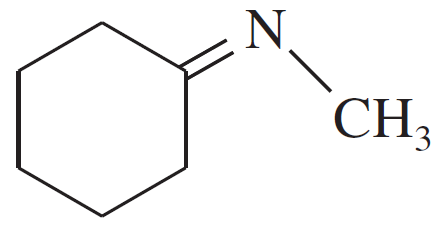
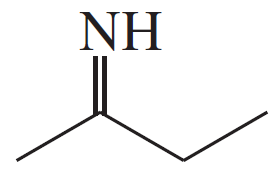
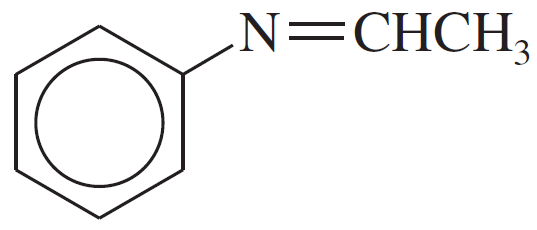
Give the structures of the carbonyl compound and the amine used to form the following imines.
(a)
(b)
(c)

Guida verificata passo dopo passo
1
Step 1: Understand the reaction that forms imines. Imines are formed by the condensation reaction between a carbonyl compound (aldehyde or ketone) and a primary amine. The reaction involves the nucleophilic attack of the amine on the carbonyl carbon, followed by dehydration to form the imine.
Step 2: Analyze structure (a). The imine shown has a double bond between the carbon and nitrogen, with two methyl groups attached to the carbon. This indicates that the carbonyl compound used was acetone (CH₃COCH₃), and the amine used was ammonia (NH₃).
Step 3: Analyze structure (b). The imine has a cyclopentyl group attached to the carbon and a CHCH₃ group attached to the nitrogen. This suggests that the carbonyl compound was cyclopentanone (C₅H₈O), and the amine used was ethylamine (CH₃CH₂NH₂).
Step 4: Analyze structure (c). The imine is a cyclic structure with a nitrogen atom incorporated into the ring. This indicates that the carbonyl compound was cyclohexanone (C₆H₁₀O), and the amine used was ammonia (NH₃).
Step 5: Summarize the findings. For each imine: (a) Acetone and ammonia, (b) Cyclopentanone and ethylamine, (c) Cyclohexanone and ammonia. These combinations of carbonyl compounds and amines lead to the respective imines shown in the problem.

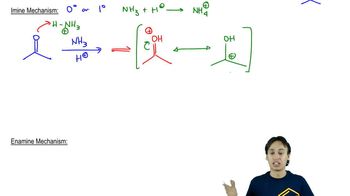
Risposta video verificata per un problema simile:

Questa soluzione video è stata consigliata dai nostri tutor come utile per risolvere questo problema.
Durata del video:
5m

Concetti chiave

Ecco i concetti essenziali che devi comprendere per rispondere correttamente alla domanda.

Carbonyl Compounds

Carbonyl compounds contain a carbon atom double-bonded to an oxygen atom (C=O). This functional group is pivotal in organic chemistry, as it is involved in various reactions, including the formation of imines. Common examples include aldehydes and ketones, which can react with amines to form imines through a condensation reaction, releasing water.
Video consigliato:
01:40
Defining meso compounds.

Amines

Amines are organic compounds derived from ammonia (NH3) by replacing one or more hydrogen atoms with alkyl or aryl groups. They can act as nucleophiles due to the lone pair of electrons on the nitrogen atom, allowing them to react with carbonyl compounds to form imines. Amines can be classified as primary, secondary, or tertiary based on the number of carbon groups attached to the nitrogen.
Video consigliato:
07:12
Reductive Amination

Imines

Imines are compounds characterized by a carbon-nitrogen double bond (C=N), formed when a carbonyl compound reacts with an amine. This reaction typically involves the nucleophilic attack of the amine on the carbonyl carbon, followed by dehydration. Imines are important intermediates in organic synthesis and can undergo further reactions, such as hydrolysis or reduction.
Video consigliato:
06:23
Imine Mechanism