Ch. 18 - Ketones and Aldehydes
Wade - Organic Chemistry 9th Edition
Wade9th EditionOrganic ChemistryISBN: 9780135213728Non è quello che usi tu?Cambia libro di testo
Capitolo 18, Problema 34d

Predict the major products of the following reactions.
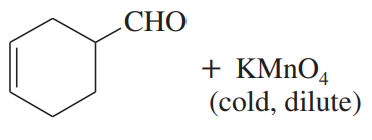
(d) Chemical structure of a benzaldehyde with the formula CHO, reacting with cold, dilute potassium permanganate (KMnO4).

Guida verificata passo dopo passo
1
Step 1: Analyze the reactants. The given compound is an aromatic aldehyde (benzaldehyde) with a double bond in the ring. The reagent is potassium permanganate (KMnO4) under cold and dilute conditions, which typically performs mild oxidation reactions.
Step 2: Understand the reaction conditions. Cold, dilute KMnO4 is a mild oxidizing agent that can oxidize alkenes to diols (glycols) via hydroxylation, but it does not oxidize aldehydes under these conditions.
Step 3: Predict the reaction on the double bond. The double bond in the aromatic ring will undergo hydroxylation, resulting in the formation of a cis-1,2-diol (two hydroxyl groups added to adjacent carbons of the double bond).
Step 4: Consider the aldehyde group. Under cold, dilute KMnO4 conditions, the aldehyde group remains unaffected because these conditions are not strong enough to oxidize aldehydes to carboxylic acids.
Step 5: Combine the results. The major product will be the aromatic ring with a cis-1,2-diol on the double bond and the aldehyde group intact.

Risposta video verificata per un problema simile:

Questa soluzione video è stata consigliata dai nostri tutor come utile per risolvere questo problema.
Durata del video:
3m

Concetti chiave

Ecco i concetti essenziali che devi comprendere per rispondere correttamente alla domanda.

Reaction Mechanisms

Understanding reaction mechanisms is crucial in organic chemistry as they describe the step-by-step process by which reactants transform into products. This includes identifying intermediates, transition states, and the movement of electrons. Familiarity with mechanisms helps predict the outcome of reactions and the stability of products formed.
Video consigliato:
02:16
Heck Reaction Mechanism

Functional Groups

Functional groups are specific groups of atoms within molecules that are responsible for the characteristic chemical reactions of those molecules. Recognizing functional groups allows chemists to predict reactivity patterns and the types of reactions that can occur. This knowledge is essential for determining the major products in organic reactions.
Video consigliato:
02:36
Identifying Functional Groups

Regioselectivity and Stereoselectivity

Regioselectivity refers to the preference of a chemical reaction to yield one structural isomer over others, while stereoselectivity involves the preference for one stereoisomer over another. These concepts are important for predicting the major products of reactions, as they influence the distribution of products based on the reaction conditions and the nature of the reactants.
Video consigliato:
05:09
Heck Reaction