Ch. 18 - Ketones and Aldehydes
Wade - Organic Chemistry 9th Edition
Wade9th EditionOrganic ChemistryISBN: 9780135213728Non è quello che usi tu?Cambia libro di testo
Capitolo 18, Problema 29b

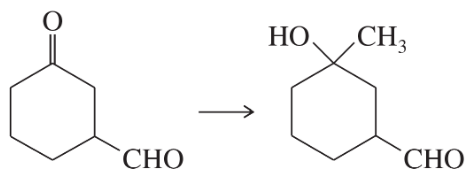
Show how you would accomplish the following syntheses. You may use whatever additional reagents you need.
(b)

Guida verificata passo dopo passo
1
Step 1: Analyze the starting material and the product. The starting material is a cyclohexane ring with a ketone group and an aldehyde group. The product has a cyclohexane ring with an alcohol group, a methyl group, and an aldehyde group. This indicates that the ketone group is converted into a tertiary alcohol, and a methyl group is added.
Step 2: To convert the ketone group into a tertiary alcohol, perform a nucleophilic addition reaction using a Grignard reagent. Prepare the Grignard reagent, CH3MgBr, which will add a methyl group to the ketone carbon.
Step 3: React the starting material with the Grignard reagent (CH3MgBr) in an ether solvent. This will result in the formation of a tertiary alcohol at the ketone position, with the methyl group added.
Step 4: After the Grignard reaction, perform an acidic workup (e.g., using H3O+) to protonate the alkoxide intermediate and yield the final tertiary alcohol product.
Step 5: Verify that the aldehyde group remains intact throughout the reaction sequence, as it is not reactive under the conditions used for the Grignard reaction.

Risposta video verificata per un problema simile:

Questa soluzione video è stata consigliata dai nostri tutor come utile per risolvere questo problema.
Durata del video:
6m

Concetti chiave

Ecco i concetti essenziali che devi comprendere per rispondere correttamente alla domanda.

Organic Synthesis

Organic synthesis is the process of constructing organic compounds through chemical reactions. It involves the strategic selection of starting materials and reagents to achieve a desired product. Understanding the principles of synthesis is crucial for designing pathways that efficiently convert reactants into target molecules while considering factors like yield and selectivity.
Video consigliato:
Percorso guidato
1:16
Synthesis of Amino Acids: Strecker Synthesis Example 1

Reaction Mechanisms

A reaction mechanism describes the step-by-step sequence of elementary reactions that occur during a chemical transformation. It provides insight into how bonds are broken and formed, helping predict the products of a reaction. Familiarity with common mechanisms, such as nucleophilic substitution or electrophilic addition, is essential for planning syntheses and understanding the behavior of reagents.
Video consigliato:
02:16
Heck Reaction Mechanism

Reagents and Conditions

The choice of reagents and reaction conditions significantly influences the outcome of a synthesis. Reagents can include acids, bases, catalysts, and solvents, each affecting the reaction's rate and selectivity. Understanding how different conditions, such as temperature and pressure, impact reactions is vital for optimizing synthetic routes and achieving desired products.
Video consigliato:
01:52
Reagents