Ch. 19 - Amines
Wade - Organic Chemistry 9th Edition
Wade9th EditionOrganic ChemistryISBN: 9780135213728Non è quello che usi tu?Cambia libro di testo
Capitolo 19, Problema 39h

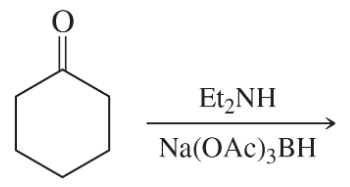
Predict the products of the following reactions:
(h)

Guida verificata passo dopo passo
1
Step 1: Identify the reactants and reagents. The starting material is cyclohexanone, a ketone. The reagents are diethylamine (Et2NH) and sodium triacetoxyborohydride (Na(OAc)3BH), which is commonly used for reductive amination reactions.
Step 2: Understand the mechanism of reductive amination. In this reaction, the ketone (cyclohexanone) reacts with the amine (diethylamine) to form an imine intermediate. This occurs through a nucleophilic attack of the amine on the carbonyl carbon of the ketone, followed by dehydration to form the imine.
Step 3: Recognize the role of Na(OAc)3BH. Sodium triacetoxyborohydride is a mild reducing agent that selectively reduces the imine intermediate to form the corresponding amine. This avoids over-reduction and ensures the reaction proceeds efficiently.
Step 4: Predict the product structure. The final product will be a secondary amine where the diethylamine group is attached to the cyclohexane ring at the position of the original carbonyl group.
Step 5: Confirm stereochemistry considerations. Since the reaction involves the formation of a new chiral center, the product may exist as a mixture of stereoisomers unless the reaction conditions favor one specific stereoisomer.

Risposta video verificata per un problema simile:

Questa soluzione video è stata consigliata dai nostri tutor come utile per risolvere questo problema.
Durata del video:
2m

Concetti chiave

Ecco i concetti essenziali che devi comprendere per rispondere correttamente alla domanda.

Nucleophilic Addition

Nucleophilic addition is a fundamental reaction in organic chemistry where a nucleophile attacks an electrophilic carbon atom, typically found in carbonyl compounds. In this case, diethylamine (Et2NH) acts as the nucleophile, attacking the carbonyl carbon of the cyclic compound, leading to the formation of an intermediate that can further react.
Video consigliato:
08:27
Nucleophilic Addition

Reduction Reactions

Reduction reactions involve the gain of electrons or a decrease in oxidation state by a molecule. Sodium triacetoxyborohydride (Na(OAc)3BH) is a mild reducing agent that can convert carbonyl groups into alcohols. In this reaction, after the nucleophilic addition, the carbonyl group is reduced to an alcohol, resulting in a more stable product.
Video consigliato:
07:12
Reductive Amination

Mechanism of Reaction

Understanding the mechanism of a reaction is crucial for predicting products. The mechanism outlines the step-by-step process of how reactants transform into products, including bond formation and breaking. In this case, the mechanism involves the nucleophilic attack by diethylamine followed by the reduction of the resulting intermediate by sodium triacetoxyborohydride, leading to the final product.
Video consigliato:
02:16
Heck Reaction Mechanism