Ch. 19 - Amines
Wade - Organic Chemistry 9th Edition
Wade9th EditionOrganic ChemistryISBN: 9780135213728Non è quello che usi tu?Cambia libro di testo
Capitolo 19, Problema 18

What would happen in the synthesis of sulfanilamide if the amino group were not protected as an amide in the chlorosulfonation step?

Guida verificata passo dopo passo
1
Understand the role of the amino group in the reaction: The amino group (-NH2) is highly nucleophilic, meaning it can readily react with electrophiles. In the chlorosulfonation step, the electrophilic reagent (e.g., chlorosulfonic acid, ClSO3H) would target nucleophilic sites in the molecule.
Recognize the purpose of protecting groups: Protecting the amino group as an amide (e.g., acetamide) reduces its nucleophilicity, preventing it from reacting with the chlorosulfonic acid. This ensures that the sulfonation occurs selectively at the desired position on the aromatic ring.
Predict the outcome without protection: If the amino group is not protected, it would likely react with the chlorosulfonic acid, forming undesired byproducts such as sulfonamides or other derivatives. This would interfere with the intended sulfonation of the aromatic ring.
Consider the impact on the synthesis: The formation of byproducts would reduce the yield of the desired sulfanilamide and complicate the purification process. Additionally, the reaction might not proceed efficiently due to competing side reactions.
Conclude the importance of protection: Protecting the amino group as an amide ensures the reaction proceeds with high selectivity and efficiency, leading to the successful synthesis of sulfanilamide. This highlights the critical role of protecting groups in multi-step organic syntheses.

Risposta video verificata per un problema simile:

Questa soluzione video è stata consigliata dai nostri tutor come utile per risolvere questo problema.
Durata del video:
5m

Concetti chiave

Ecco i concetti essenziali che devi comprendere per rispondere correttamente alla domanda.

Chlorosulfonation

Chlorosulfonation is a chemical reaction where a sulfonyl chloride group is introduced into an organic molecule using chlorosulfonic acid. This process is crucial in the synthesis of sulfanilamide, as it allows for the introduction of a sulfonamide functional group. If the amino group is not protected, it may react with the chlorosulfonic acid, leading to unwanted side reactions and potentially altering the desired product.

Protection of Functional Groups

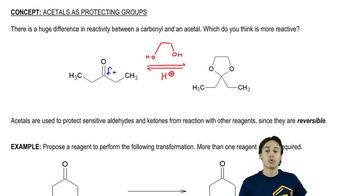
In organic synthesis, protecting groups are used to temporarily mask reactive functional groups to prevent them from participating in unwanted reactions. In the case of sulfanilamide synthesis, protecting the amino group as an amide ensures that it remains unreactive during the chlorosulfonation step. This strategy is essential for maintaining the integrity of the desired product and achieving a successful synthesis.
Video consigliato:
02:44
Protecting Groups

Sulfanilamide Structure and Function

Sulfanilamide is a sulfonamide antibiotic that contains an amino group and a sulfonamide group. The specific arrangement of these functional groups is critical for its biological activity. If the amino group is not protected during synthesis, it could lead to the formation of byproducts or alter the sulfanilamide structure, potentially affecting its efficacy as an antibiotic.
Video consigliato:
02:36
Identifying Functional Groups