Ch. 19 - Amines
Wade - Organic Chemistry 9th Edition
Wade9th EditionOrganic ChemistryISBN: 9780135213728Non è quello che usi tu?Cambia libro di testo
Capitolo 19, Problema 22a

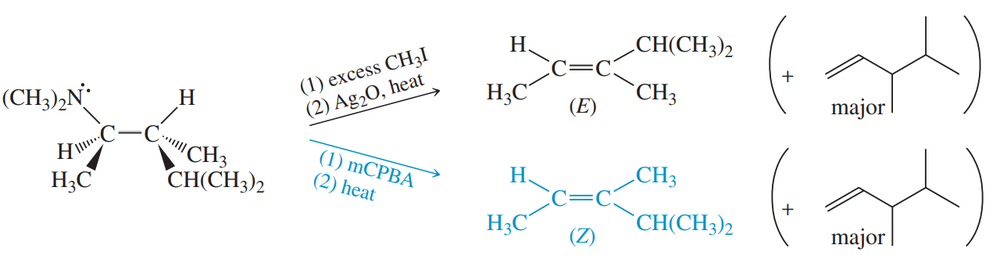
When the (R,R) isomer of the amine shown is treated with an excess of methyl iodide, then silver oxide, then heated, the major product is the Hofmann product.
(a) Draw the structure of the major (Hofmann) product.
Stereochemical drawings illustrate amine reactions, showing Hofmann and Zaitsev products with (E) and (Z) configurations.

Guida verificata passo dopo passo
1
Step 1: Recognize that the reaction involves the Hofmann elimination process, which occurs when an amine is treated with excess methyl iodide, followed by silver oxide and heat. This process converts the amine into a quaternary ammonium salt, which undergoes elimination to form an alkene.
Step 2: Analyze the starting amine structure. The given amine is a tertiary amine with two methyl groups and a bulky isopropyl group attached to the nitrogen. The elimination will occur to form the least substituted alkene (Hofmann product) due to steric hindrance.
Step 3: Treat the amine with excess methyl iodide. This step methylates the nitrogen, forming a quaternary ammonium iodide salt. The nitrogen now has a positive charge, and the iodide acts as a counterion.
Step 4: Add silver oxide (Ag2O) and water. This step replaces the iodide ion with a hydroxide ion, forming a quaternary ammonium hydroxide salt. The hydroxide ion acts as a base in the elimination reaction.
Step 5: Heat the quaternary ammonium hydroxide salt. The elimination reaction occurs, and the least substituted alkene (Hofmann product) is formed as the major product. In this case, the major product is the terminal alkene, as shown in the diagram.

Risposta video verificata per un problema simile:

Questa soluzione video è stata consigliata dai nostri tutor come utile per risolvere questo problema.
Durata del video:
3m

Concetti chiave

Ecco i concetti essenziali che devi comprendere per rispondere correttamente alla domanda.

Hofmann Rearrangement

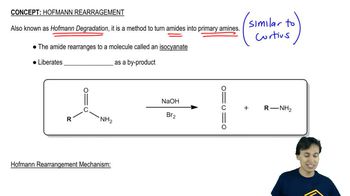
The Hofmann rearrangement is a chemical reaction that converts primary amides into primary amines with the loss of one carbon atom. This reaction involves the treatment of the amide with halogens and a base, leading to the formation of an isocyanate intermediate, which is then hydrolyzed to yield the amine. Understanding this mechanism is crucial for predicting the products when an amine is treated with methyl iodide and silver oxide.
Video consigliato:
02:51
General Reaction

Methylation of Amines

Methylation of amines involves the introduction of a methyl group into the amine structure, typically using methyl iodide as a methylating agent. This process can lead to the formation of N-methylated products, which can further react under certain conditions. Recognizing how methylation affects the structure and reactivity of amines is essential for determining the final product in the given reaction sequence.
Video consigliato:
06:50
Naming Primary Amines

Sterics and Reactivity in Organic Chemistry

Sterics refers to the spatial arrangement of atoms in a molecule and how this affects its reactivity. In the context of the (R,R) isomer of the amine, steric hindrance can influence the outcome of reactions, such as the Hofmann rearrangement and subsequent methylation. Understanding steric effects is vital for predicting which products will be favored in a reaction, especially when multiple pathways are possible.
Video consigliato:
00:56
What is an organic molecule?