
Domanda del libro di testo
Propose a mechanism for the following ring-opening transesterification. Use the mechanism in Problem 21-13 as a model.
918
views
 Guida verificata passo dopo passo

 03:09

 1:21
 2:50
Propose a mechanism for the following ring-opening transesterification. Use the mechanism in Problem 21-13 as a model.
Suppose we have some optically pure (R)-2-butyl acetate that has been 'labeled' with the heavy 18O isotope at one oxygen atom as shown.
(c) Explain how you would prove experimentally where the 18O label appears in the products. (18O is not radioactive.)
Suppose we have some optically pure (R)-2-butyl acetate that has been "labeled" with the heavy 18O isotope at one oxygen atom as shown.
(b) Repeat part (a) for the acid-catalyzed hydrolysis of this compound.
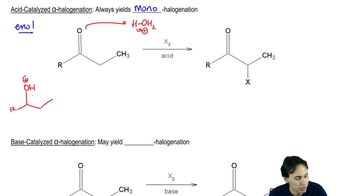
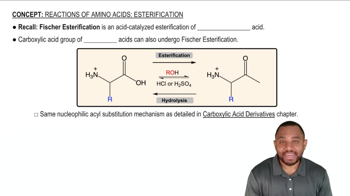
Propose a mechanism for the acid-catalyzed hydrolysis of phenylalanine ethyl ester.
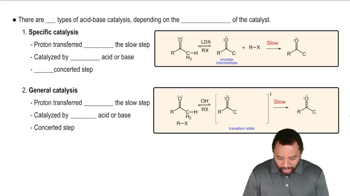
Acid-catalyzed transesterification:
Complete the mechanism for this acid-catalyzed transesterification by drawing out all the individual steps. Draw the important resonance contributors for each resonance-stabilized intermediate.
Suppose we have some optically pure (R)-2-butyl acetate that has been 'labeled' with the heavy 18O isotope at one oxygen atom as shown.
(a) Draw a mechanism for the hydrolysis of this compound under basic conditions. Predict which of the products will contain the 18O label. Also predict whether the butan-2-ol product will be pure (R), pure (S), or racemized.