Ch. 21 - Carboxylic Acid Derivatives
Wade - Organic Chemistry 9th Edition
Wade9th EditionOrganic ChemistryISBN: 9780135213728Non è quello che usi tu?Cambia libro di testo
Capitolo 21, Problema 6e

Propose a mechanism for the reaction of aniline with ethyl acetate to give acetanilide. What is the leaving group in your proposed mechanism? Would this be a suitable leaving group for an SN2 reaction?

Guida verificata passo dopo passo
1
Step 1: Understand the reaction. Aniline (C₆H₅NH₂) reacts with ethyl acetate (CH₃COOCH₂CH₃) to form acetanilide (C₆H₅NHCOCH₃). This is an example of a nucleophilic acyl substitution reaction, where the nucleophile (aniline) attacks the carbonyl carbon of ethyl acetate.
Step 2: Propose the first step of the mechanism. The lone pair of electrons on the nitrogen atom of aniline attacks the electrophilic carbonyl carbon of ethyl acetate. This forms a tetrahedral intermediate, where the carbonyl oxygen becomes negatively charged.
Step 3: Identify the leaving group. In the tetrahedral intermediate, the ethoxy group (-OCH₂CH₃) is a good leaving group. The negatively charged oxygen reforms the carbonyl bond, expelling the ethoxy group as ethanol (CH₃CH₂OH).
Step 4: Analyze the leaving group for SN2 suitability. The ethoxy group (-OCH₂CH₃) is not a suitable leaving group for an SN2 reaction because it is a strong base and does not leave easily under SN2 conditions. SN2 reactions typically require weak bases as leaving groups, such as halides (e.g., Cl⁻, Br⁻, I⁻).
Step 5: Conclude the mechanism. The final product, acetanilide, is formed after the ethoxy group leaves and the carbonyl bond is reformed. The reaction proceeds via nucleophilic acyl substitution, not an SN2 mechanism, due to the nature of the leaving group and the reaction conditions.

Risposta video verificata per un problema simile:

Questa soluzione video è stata consigliata dai nostri tutor come utile per risolvere questo problema.
Durata del video:
4m

Concetti chiave

Ecco i concetti essenziali che devi comprendere per rispondere correttamente alla domanda.

Nucleophilic Acyl Substitution

Nucleophilic acyl substitution is a fundamental reaction mechanism in organic chemistry where a nucleophile attacks an electrophilic carbonyl carbon, leading to the substitution of a leaving group. In the case of aniline reacting with ethyl acetate, the amine acts as the nucleophile, attacking the carbonyl carbon of the ester, resulting in the formation of acetanilide and the release of an acetate ion as the leaving group.
Video consigliato:
01:47
Nucleophiles and Electrophiles can react in Substitution Reactions.

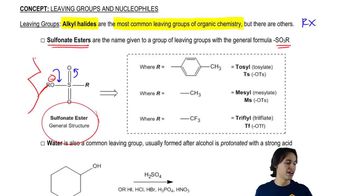
Leaving Groups

A leaving group is an atom or group that can depart with a pair of electrons in a chemical reaction, facilitating the formation of a new bond. In the proposed mechanism, the acetate ion (derived from ethyl acetate) serves as the leaving group. Good leaving groups are typically stable after departure, and acetate is considered a moderate leaving group due to its ability to stabilize the negative charge.
Video consigliato:
07:22
The 3 important leaving groups to know.

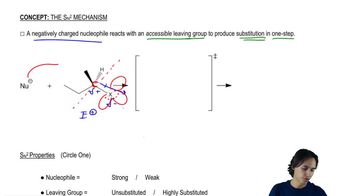
SN2 Reaction Mechanism

The SN2 (substitution nucleophilic bimolecular) mechanism involves a single concerted step where a nucleophile attacks an electrophile, leading to the simultaneous displacement of a leaving group. For a leaving group to be suitable for an SN2 reaction, it must be able to stabilize the transition state and depart easily. While acetate is a reasonable leaving group for many reactions, it is not ideal for SN2 due to steric hindrance and the nature of the substrate involved.
Video consigliato:
08:33
Drawing the SN2 Mechanism