Ch. 21 - Carboxylic Acid Derivatives
Wade - Organic Chemistry 9th Edition
Wade9th EditionOrganic ChemistryISBN: 9780135213728Non è quello che usi tu?Cambia libro di testo
Capitolo 21, Problema 47d

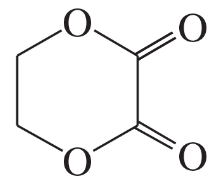
Predict the products of saponification of the following esters.
(d)

Guida verificata passo dopo passo
1
Step 1: Recognize that saponification is the base-catalyzed hydrolysis of esters. In this reaction, the ester reacts with a strong base (e.g., NaOH or KOH) to produce a carboxylate salt and an alcohol.
Step 2: Analyze the given structure. The molecule is a cyclic diester (lactone) with two ester functional groups. Each ester group will undergo hydrolysis during saponification.
Step 3: Write the reaction mechanism for the saponification of one ester group. The hydroxide ion (OH⁻) attacks the carbonyl carbon of the ester, leading to the formation of a tetrahedral intermediate. This intermediate collapses, releasing the alcohol and forming a carboxylate ion.
Step 4: Repeat the saponification process for the second ester group in the molecule. Since the molecule is symmetric, the same reaction occurs at the second ester group, producing another carboxylate ion and another alcohol molecule.
Step 5: Combine the products. The final products of the saponification of this cyclic diester are two molecules of alcohol (likely 1,2-ethanediol, based on the structure) and a dicarboxylate salt (likely sodium succinate if NaOH is used).

Risposta video verificata per un problema simile:

Questa soluzione video è stata consigliata dai nostri tutor come utile per risolvere questo problema.
Durata del video:
2m

Concetti chiave

Ecco i concetti essenziali che devi comprendere per rispondere correttamente alla domanda.

Saponification

Saponification is a chemical reaction that involves the hydrolysis of esters in the presence of a strong base, typically sodium hydroxide (NaOH) or potassium hydroxide (KOH). This process results in the formation of an alcohol and a carboxylate salt, which is commonly known as soap. Understanding this reaction is crucial for predicting the products when esters undergo saponification.
Video consigliato:
03:27
Mechanism

Esters

Esters are organic compounds formed from the reaction of an alcohol and a carboxylic acid, characterized by the functional group -COO-. They are often responsible for the pleasant aromas of fruits and flowers. In the context of saponification, recognizing the structure of the ester is essential for determining the resulting products after the reaction with a base.
Video consigliato:
02:39
Ester Nomenclature

Functional Groups

Functional groups are specific groups of atoms within molecules that are responsible for the characteristic chemical reactions of those molecules. In organic chemistry, identifying functional groups such as esters, alcohols, and carboxylic acids is vital for predicting the behavior of compounds during reactions like saponification. The presence of these groups influences the reactivity and the products formed in chemical transformations.
Video consigliato:
02:36
Identifying Functional Groups