Ch. 21 - Carboxylic Acid Derivatives
Wade - Organic Chemistry 9th Edition
Wade9th EditionOrganic ChemistryISBN: 9780135213728Non è quello che usi tu?Cambia libro di testo
Capitolo 21, Problema 50b

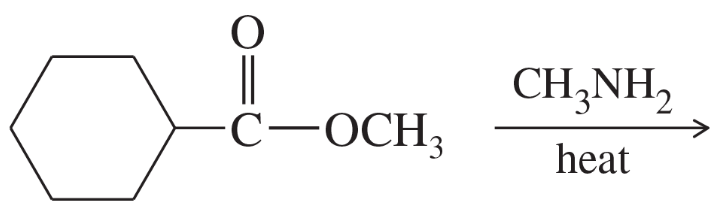
Predict the products of the following reactions.
(b)

Guida verificata passo dopo passo
1
Step 1: Identify the functional groups in the reactants. The starting compound contains an ester group (R-COOCH3), and the reagent is methylamine (CH3NH2), which is a primary amine.
Step 2: Recognize the type of reaction. This is a nucleophilic acyl substitution reaction, where the amine will act as a nucleophile and attack the carbonyl carbon of the ester.
Step 3: Describe the mechanism. The lone pair of electrons on the nitrogen atom of CH3NH2 will attack the electrophilic carbonyl carbon of the ester, forming a tetrahedral intermediate.
Step 4: Explain the elimination step. The intermediate will collapse, expelling the methoxy group (-OCH3) as a leaving group and forming an amide bond (R-CONHCH3).
Step 5: Predict the product. The final product will be an amide, specifically N-methylcyclohexanecarboxamide, where the ester group is replaced by the amide group.

Risposta video verificata per un problema simile:

Questa soluzione video è stata consigliata dai nostri tutor come utile per risolvere questo problema.
Durata del video:
47s

Concetti chiave

Ecco i concetti essenziali che devi comprendere per rispondere correttamente alla domanda.

Nucleophilic Addition Reactions

Nucleophilic addition reactions involve the attack of a nucleophile, such as an amine, on an electrophilic carbon atom, typically found in carbonyl groups. In this case, methylamine (CH3NH2) acts as the nucleophile, attacking the carbonyl carbon of the cyclic compound, leading to the formation of an intermediate that can further react to yield the final product.
Video consigliato:
08:27
Nucleophilic Addition

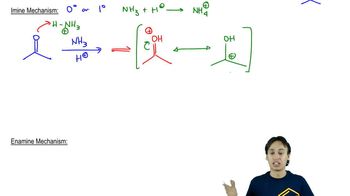
Formation of Imine

When an amine reacts with a carbonyl compound, it can form an imine through a condensation reaction. This process involves the nucleophilic attack of the amine on the carbonyl carbon, followed by the elimination of water. The heat applied in the reaction can facilitate this transformation, promoting the formation of the imine product from the initial adduct.
Video consigliato:
06:23
Imine Mechanism

Reactivity of Carbonyl Compounds

Carbonyl compounds, such as ketones and aldehydes, are highly reactive due to the polarized carbon-oxygen double bond. The carbon atom is electrophilic, making it susceptible to nucleophilic attack. In this reaction, the presence of the methoxy group (OCH3) can influence the reactivity and stability of the carbonyl, affecting the overall reaction pathway and product formation.
Video consigliato:
01:40
Defining meso compounds.