Ch. 21 - Carboxylic Acid Derivatives
Wade - Organic Chemistry 9th Edition
Wade9th EditionOrganic ChemistryISBN: 9780135213728Non è quello che usi tu?Cambia libro di testo
Capitolo 21, Problema 45d

Predict the products of the following reactions.
(d) anisole + succinic anhydride and aluminum chloride

Guida verificata passo dopo passo
1
Identify the type of reaction: This is a Friedel-Crafts acylation reaction, where anisole (methoxybenzene) reacts with succinic anhydride in the presence of aluminum chloride (AlCl₃), a Lewis acid catalyst.
Understand the role of the reagents: Succinic anhydride acts as the acylating agent, and AlCl₃ activates the carbonyl group of the anhydride by forming a complex, making it more electrophilic.
Determine the electrophile: The electrophile generated in this reaction is a resonance-stabilized acylium ion, which is formed when AlCl₃ reacts with succinic anhydride. The acylium ion has the structure \( \text{CH}_2\text{CO}^+ \).
Predict the site of electrophilic attack: The methoxy group (\( \text{-OCH}_3 \)) on anisole is an electron-donating group, activating the benzene ring and directing the electrophilic substitution to the ortho and para positions relative to the methoxy group.
Combine the electrophile and anisole: The acylium ion will attack the activated benzene ring of anisole, leading to the formation of ortho- and para-substituted products. The major product is typically the para-substituted product due to steric hindrance at the ortho position.

Risposta video verificata per un problema simile:

Questa soluzione video è stata consigliata dai nostri tutor come utile per risolvere questo problema.
Durata del video:
3m

Concetti chiave

Ecco i concetti essenziali che devi comprendere per rispondere correttamente alla domanda.

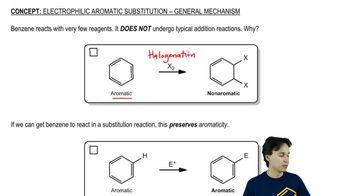
Electrophilic Aromatic Substitution

Electrophilic aromatic substitution (EAS) is a fundamental reaction in organic chemistry where an electrophile replaces a hydrogen atom on an aromatic ring. In this case, anisole, which has a methoxy group that donates electron density, will undergo EAS with succinic anhydride in the presence of aluminum chloride, a Lewis acid that activates the anhydride for reaction.
Video consigliato:
03:07
EAS Review

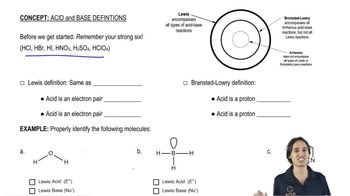
Role of Lewis Acids

Lewis acids, such as aluminum chloride, are substances that can accept an electron pair. In this reaction, aluminum chloride enhances the electrophilicity of succinic anhydride, facilitating its attack on the electron-rich aromatic ring of anisole. This interaction is crucial for the successful formation of the product.
Video consigliato:
02:49
The Lewis definition of acids and bases.

Product Formation and Mechanism

The reaction between anisole and succinic anhydride leads to the formation of an acylated product through a mechanism that involves the generation of a resonance-stabilized carbocation intermediate. The final product will be an aromatic compound with a succinyl group attached, demonstrating the importance of understanding reaction mechanisms in predicting organic reaction outcomes.
Video consigliato:
12:11
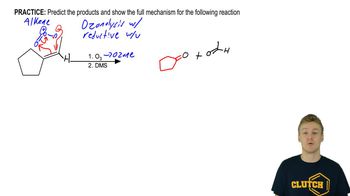
Predict the products and show the mechanism: