Ch. 21 - Carboxylic Acid Derivatives
Wade - Organic Chemistry 9th Edition
Wade9th EditionOrganic ChemistryISBN: 9780135213728Non è quello che usi tu?Cambia libro di testo
Capitolo 21, Problema 50i

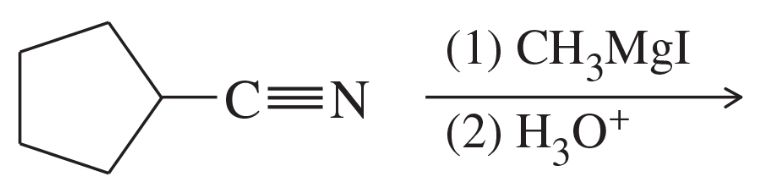
Predict the products of the following reactions.
(i)

Guida verificata passo dopo passo
1
Step 1: Identify the functional group in the starting material. The molecule contains a nitrile group (-C≡N) attached to a cyclopentane ring.
Step 2: Recognize the reagents used in the reaction. The first reagent is CH₃MgI, a Grignard reagent, which is nucleophilic and reacts with the electrophilic carbon in the nitrile group. The second reagent is H₃O⁺, which is used for hydrolysis.
Step 3: Understand the mechanism of the reaction. The Grignard reagent adds to the carbon of the nitrile group, breaking the triple bond and forming an intermediate imine (R-C=N-R').
Step 4: The imine intermediate undergoes hydrolysis in the presence of H₃O⁺, converting it into a ketone. The final product will have a ketone functional group where the nitrile group was originally located.
Step 5: Combine the structural changes. The cyclopentane ring remains intact, and the methyl group from CH₃MgI is added to the carbon of the former nitrile group, resulting in a methyl ketone (cyclopentanone with a methyl substituent).

Risposta video verificata per un problema simile:

Questa soluzione video è stata consigliata dai nostri tutor come utile per risolvere questo problema.
Durata del video:
1m

Concetti chiave

Ecco i concetti essenziali che devi comprendere per rispondere correttamente alla domanda.

Nitrile Reactivity

Nitriles are organic compounds containing a cyano group (-C≡N). They are reactive towards nucleophiles due to the polarized carbon-nitrogen triple bond. In this reaction, the nitrile acts as an electrophile, allowing nucleophilic attack by reagents like Grignard reagents, which can lead to the formation of an intermediate that can be further hydrolyzed.
Video consigliato:
01:01
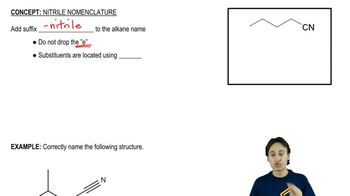
Nitrile Nomenclature

Grignard Reagents

Grignard reagents, such as CH3MgI, are organomagnesium compounds that act as strong nucleophiles. They readily react with electrophiles, including carbonyls and nitriles, to form new carbon-carbon bonds. In this case, the Grignard reagent will attack the carbon of the nitrile, resulting in the formation of an intermediate that can be converted into an amine upon hydrolysis.
Video consigliato:
02:12
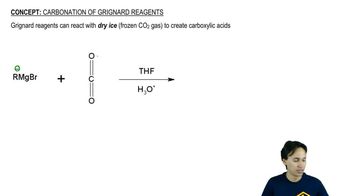
Carbonation of Grignard Reagents

Acidic Workup

The acidic workup, typically involving H3O+, is a crucial step in organic reactions following nucleophilic additions. It serves to protonate the intermediate formed after the nucleophilic attack, converting it into a more stable product. In this reaction, the acidic workup will hydrolyze the nitrile-derived intermediate, yielding an amine as the final product.
Video consigliato:
01:31
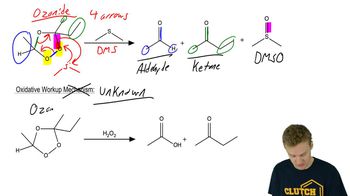
Oxidative Workup Mechanism: