Ch. 21 - Carboxylic Acid Derivatives
Wade - Organic Chemistry 9th Edition
Wade9th EditionOrganic ChemistryISBN: 9780135213728Non è quello che usi tu?Cambia libro di testo
Capitolo 21, Problema 54a

Show how you would accomplish the following syntheses. Some of these conversions may require more than one step.
(a) isopentyl alcohol → isopentyl acetate (banana oil)

Guida verificata passo dopo passo
1
Identify the functional group transformation: The conversion involves transforming isopentyl alcohol (an alcohol) into isopentyl acetate (an ester). This is a classic esterification reaction.
Choose the appropriate reagents: To synthesize an ester from an alcohol, you can use acetic acid (CH₃COOH) and a strong acid catalyst, such as sulfuric acid (H₂SO₄), in a Fischer esterification reaction.
Write the reaction mechanism: The alcohol (isopentyl alcohol) reacts with acetic acid in the presence of the acid catalyst. The hydroxyl group (-OH) from the alcohol and a hydrogen atom from the carboxylic acid combine to form water (H₂O), leaving behind the ester bond.
Set up the reaction conditions: Mix isopentyl alcohol and acetic acid in a 1:1 molar ratio, add a few drops of concentrated sulfuric acid as the catalyst, and heat the mixture under reflux to drive the reaction to completion.
Isolate and purify the product: After the reaction is complete, use techniques such as extraction to separate the ester layer, followed by washing with water and drying over an anhydrous agent. Finally, distill the product to obtain pure isopentyl acetate.

Risposta video verificata per un problema simile:

Questa soluzione video è stata consigliata dai nostri tutor come utile per risolvere questo problema.
Durata del video:
1m

Concetti chiave

Ecco i concetti essenziali che devi comprendere per rispondere correttamente alla domanda.

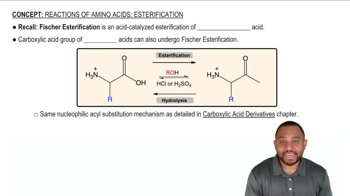
Esterification

Esterification is a chemical reaction that forms an ester from an alcohol and a carboxylic acid. In the case of synthesizing isopentyl acetate from isopentyl alcohol, the reaction involves combining isopentyl alcohol with acetic acid, typically in the presence of an acid catalyst, to facilitate the reaction and drive it to completion.
Video consigliato:
Percorso guidato
1:21
Reactions of Amino Acids: Esterification Concept 1

Reflux

Reflux is a technique used in organic chemistry to heat a reaction mixture while preventing the loss of volatile components. This is achieved by using a condenser to cool and return vapors back to the reaction vessel. In the synthesis of isopentyl acetate, refluxing the mixture of isopentyl alcohol and acetic acid ensures that the reaction proceeds efficiently and that the reactants remain in contact for an adequate time.

Reaction Mechanism

Understanding the reaction mechanism is crucial for predicting the steps involved in the conversion of reactants to products. In the esterification of isopentyl alcohol to isopentyl acetate, the mechanism involves protonation of the alcohol, nucleophilic attack by the alcohol on the carbonyl carbon of the acetic acid, and subsequent elimination of water to form the ester. Familiarity with these steps aids in optimizing conditions for the synthesis.
Video consigliato:
02:16
Heck Reaction Mechanism
Pratica correlata
Domanda del libro di testo

Two widely used pain relievers are aspirin and acetaminophen. Show how you would synthesize these drugs from phenol.

764
views

Domanda del libro di testo

Phosgene is the acid chloride of carbonic acid. Although phosgene was used as a war gas in World War I, it is now used as a reagent for the synthesis of many useful products. Phosgene reacts like other acid chlorides, but it can react twice.

(b) Predict the products formed when phosgene reacts with 1 equivalent of methanol, followed by 1 equivalent of aniline.

505
views
Domanda del libro di testo

Show how you would accomplish the following syntheses. Some of these conversions may require more than one step.

(d) ethyl acetate → 3-methylpentan-3-ol

543
views
Domanda del libro di testo

Show how you would accomplish the following syntheses. Some of these conversions may require more than one step.

(c) isobutylamine → N-isobutylformamide

532
views
Domanda del libro di testo

Show how you would accomplish the following syntheses. Some of these conversions may require more than one step.

(b) 3-ethylpentanoic acid → 3-ethylpentanenitrile

540
views
Domanda del libro di testo

An ether extraction of nutmeg gives large quantities of trimyristin, a waxy crystalline solid of melting point 57°C. The IR spectrum of trimyristin shows a very strong absorption at 1733 cm-1. Basic hydrolysis of trimyristin gives 1 equivalent of glycerol and 3 equivalents of myristic acid (tetradecanoic acid).

(a) Draw the structure of trimyristin.

(b) Predict the products formed when trimyristin is treated with lithium aluminum hydride, followed by aqueous hydrolysis of the aluminum salts.

2196
views