Ch. 21 - Carboxylic Acid Derivatives
Wade - Organic Chemistry 9th Edition
Wade9th EditionOrganic ChemistryISBN: 9780135213728Non è quello che usi tu?Cambia libro di testo
Capitolo 21, Problema 9c,d

Show how you would use appropriate acyl chlorides and amines to synthesize the following amides.
(c) cyclohexanecarboxamide
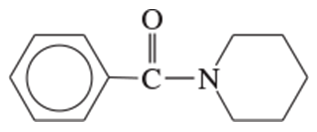
(d)

Guida verificata passo dopo passo
1
Step 1: Understand the structure of the target amides. For cyclohexanecarboxamide (part c), the amide consists of a cyclohexane ring attached to a carboxamide group (-CONH2). For part d, analyze the provided structure in the image to identify the acyl chloride and amine components required.
Step 2: Identify the acyl chloride precursor. To synthesize cyclohexanecarboxamide, the acyl chloride precursor would be cyclohexanecarbonyl chloride (C6H11COCl). For part d, examine the structure in the image to determine the aromatic acyl chloride precursor.
Step 3: Identify the amine precursor. For cyclohexanecarboxamide, the amine precursor is ammonia (NH3), which reacts with the acyl chloride to form the amide. For part d, analyze the structure in the image to identify the specific amine required (e.g., a cyclic amine or aromatic amine).
Step 4: Write the reaction mechanism. The synthesis involves a nucleophilic acyl substitution reaction. The amine attacks the carbonyl carbon of the acyl chloride, leading to the formation of the amide and the release of HCl as a byproduct.
Step 5: Ensure proper reaction conditions. The reaction typically requires a base (e.g., pyridine) to neutralize the HCl byproduct and facilitate the formation of the amide. Confirm the reaction conditions for both parts c and d based on the structures provided.

Risposta video verificata per un problema simile:

Questa soluzione video è stata consigliata dai nostri tutor come utile per risolvere questo problema.
Durata del video:
6m

Concetti chiave

Ecco i concetti essenziali che devi comprendere per rispondere correttamente alla domanda.

Acyl Chlorides

Acyl chlorides, also known as acid chlorides, are reactive derivatives of carboxylic acids where the hydroxyl group is replaced by a chlorine atom. They are highly reactive towards nucleophiles, making them useful in organic synthesis, particularly for forming amides. In the context of the question, acyl chlorides can be used to react with amines to produce the desired amides through nucleophilic acyl substitution.
Video consigliato:
01:57
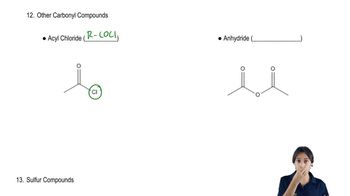
Recognizing acyl chlorides and anhydrides.

Nucleophilic Acyl Substitution

Nucleophilic acyl substitution is a fundamental reaction in organic chemistry where a nucleophile attacks the carbonyl carbon of an acyl compound, leading to the substitution of a leaving group. In the case of acyl chlorides, the leaving group is chloride, and the nucleophile can be an amine. This reaction is crucial for synthesizing amides, as it allows for the formation of a carbon-nitrogen bond while releasing HCl as a byproduct.
Video consigliato:
01:47
Nucleophiles and Electrophiles can react in Substitution Reactions.

Amides

Amides are organic compounds characterized by the presence of a carbonyl group (C=O) directly attached to a nitrogen atom (N). They can be synthesized from carboxylic acids or their derivatives, such as acyl chlorides, by reacting with amines. Amides are important in both biological systems and synthetic chemistry, serving as building blocks for proteins and pharmaceuticals, and their formation is a key reaction in organic synthesis.
Video consigliato:
01:33
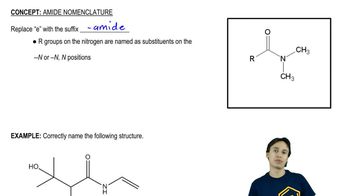
Amide Nomenclature