Ch. 22 - Condensations and Alpha Substitutions of Carbonyl Compounds
Wade - Organic Chemistry 9th Edition
Wade9th EditionOrganic ChemistryISBN: 9780135213728Non è quello che usi tu?Cambia libro di testo
Capitolo 22, Problema 66a

Rank these compounds in order of increasing acid strength.
Structures of four dicarbonyl compounds labeled A, B, C, and D, for ranking by acid strength.

Guida verificata passo dopo passo
1
Step 1: Analyze the molecular structures of the compounds (A, B, C, and D). Note the presence of functional groups, electronegative atoms, and resonance effects that influence acidity.
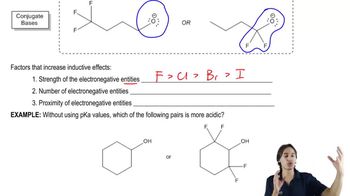
Step 2: Consider the inductive effect. Compound B contains trifluoromethyl groups (-CF3), which are highly electronegative and withdraw electron density through the inductive effect, stabilizing the conjugate base and increasing acidity.
Step 3: Evaluate resonance effects. Compound C and D have additional carbonyl groups that can participate in resonance stabilization of the conjugate base, making them more acidic than compound A.
Step 4: Compare compound A and C. Compound C has an extra carbonyl group compared to A, which increases its ability to stabilize the conjugate base through resonance, making it more acidic than A.
Step 5: Rank the compounds in order of increasing acid strength based on the combined effects of resonance and inductive stabilization: A < C < D < B.

Risposta video verificata per un problema simile:

Questa soluzione video è stata consigliata dai nostri tutor come utile per risolvere questo problema.
Durata del video:
7m

Concetti chiave

Ecco i concetti essenziali che devi comprendere per rispondere correttamente alla domanda.

Acid Strength

Acid strength refers to the ability of a compound to donate protons (H+) in a solution. Stronger acids dissociate more completely in water, resulting in a higher concentration of H+ ions. Factors influencing acid strength include the stability of the conjugate base, electronegativity of atoms, and resonance stabilization. Understanding these factors is crucial for ranking acids.
Video consigliato:
03:09
The 3 factors that determine the strength of inductive effects.

Conjugate Base Stability

The stability of a conjugate base is a key determinant of acid strength. A more stable conjugate base corresponds to a stronger acid, as it can better accommodate the negative charge after proton donation. Factors such as electronegativity, size of the atom bearing the charge, and resonance can enhance conjugate base stability, thus influencing the acid's strength.
Video consigliato:
04:31
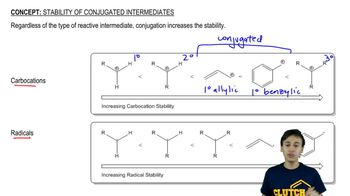
Stability of Conjugated Intermediates

Resonance Effects

Resonance effects occur when a molecule can be represented by multiple valid Lewis structures, leading to delocalization of electrons. In the context of acids, resonance can stabilize the conjugate base by spreading out the negative charge over multiple atoms. This increased stability often results in a stronger acid, making resonance a critical concept in acid strength comparisons.
Video consigliato:
03:32
Understanding Resonance Effects