Propose a mechanism for the acid-catalyzed bromination of pentan-3-one.
Ch. 22 - Condensations and Alpha Substitutions of Carbonyl Compounds
Tutti i libri di testo
Wade 9th Edition
Ch. 22 - Condensations and Alpha Substitutions of Carbonyl Compounds
Problema 16
Wade 9th Edition
Ch. 22 - Condensations and Alpha Substitutions of Carbonyl Compounds
Problema 16Capitolo 22, Problema 16
Acid-catalyzed halogenation is synthetically useful for converting ketones to α,β-unsaturated ketones, which are useful in Michael reactions (Section 22-18). Propose a method for converting cyclohexanone to cyclohex-2-en-1-one, an important synthetic starting material.

Guida verificata passo dopo passo1
Step 1: Recognize that the transformation involves converting a ketone (cyclohexanone) into an α,β-unsaturated ketone (cyclohex-2-en-1-one). This is typically achieved through an enolate intermediate followed by elimination.
Step 2: Begin by treating cyclohexanone with a catalytic amount of acid (e.g., HCl or H2SO4) to facilitate the formation of the enol tautomer. The enol tautomer is in equilibrium with the ketone form.
Step 3: Introduce a halogen source, such as Br2 or Cl2, in the presence of the acid catalyst. The enol form of cyclohexanone reacts with the halogen to form an α-halo ketone. This step is known as α-halogenation.
Step 4: Subject the α-halo ketone to a base (e.g., NaOH or KOH). The base abstracts a proton from the β-carbon, leading to the formation of a double bond between the α and β carbons. This elimination step produces the desired α,β-unsaturated ketone.
Step 5: Purify the product (cyclohex-2-en-1-one) using standard organic chemistry techniques such as distillation or recrystallization, depending on the reaction conditions and product properties.

Risposta video verificata per un problema simile:
Questa soluzione video è stata consigliata dai nostri tutor come utile per risolvere questo problema.
Durata del video:
10mConcetti chiave
Ecco i concetti essenziali che devi comprendere per rispondere correttamente alla domanda.
Acid-Catalyzed Halogenation
Acid-catalyzed halogenation involves the addition of halogens to carbonyl compounds in the presence of an acid catalyst. This reaction typically leads to the formation of α-halo ketones, which can undergo further transformations. The acid activates the carbonyl, making it more electrophilic and susceptible to nucleophilic attack by halide ions.
Video consigliato:
Acid Catalyzed
α,β-Unsaturated Ketones
α,β-Unsaturated ketones are compounds that contain a carbon-carbon double bond adjacent to a carbonyl group. These structures are important in organic synthesis as they can participate in various reactions, such as Michael additions, where nucleophiles add to the β-position. Their reactivity is influenced by the conjugation between the double bond and the carbonyl, enhancing electrophilicity.
Video consigliato:
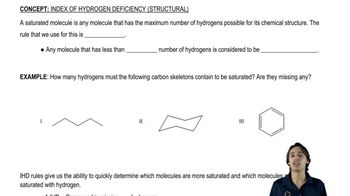
The difference between saturated and unsaturated molecules.
Michael Reaction
The Michael reaction is a nucleophilic addition reaction where a nucleophile adds to an α,β-unsaturated carbonyl compound. This reaction is significant in forming carbon-carbon bonds and is widely used in synthetic organic chemistry. The nucleophile typically attacks the β-carbon, leading to the formation of a new carbon-carbon bond and resulting in a more complex molecule.
Video consigliato:
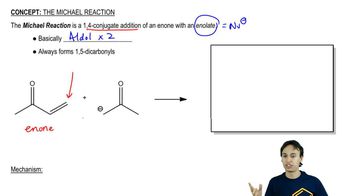
General Reaction
Pratica correlata
Domanda del libro di testo
967
views
Domanda del libro di testo
Predict the products of the following reactions.
(a) cyclopentyl methyl ketone + excess Cl2 + excess NaOH
(b) 1-cyclopentylethanol + excess I2 + excess NaOH
(c) propiophenone + excess Br2 + excess NaOH
1127
views
Domanda del libro di testo
Give the expected products for the aldol condensations of (a) propanal.
1587
views
Domanda del libro di testo
Which compounds will give positive iodoform tests?
(a) 1-phenylethanol
(b) pentan-2-one
(c) pentan-2-ol
(d) pentan-3-one
(e) acetone
(f) isopropyl alcohol
4177
views
1
comments
Domanda del libro di testo
Propose a mechanism for the aldol condensation of cyclohexanone. Do you expect the equilibrium to favor the reactant or the product?
1442
views
Domanda del libro di testo
Show the products of the reactions of these carboxylic acids with PBr3/Br2 before and after hydrolysis.
(a) pentanoic acid
(b) phenylacetic acid
(c) succinic acid
(d) oxalic acid
1617
views