Show the structure of the compound that results from hydrolysis and decarboxylation of the product.
Ch. 22 - Condensations and Alpha Substitutions of Carbonyl Compounds
Tutti i libri di testo
Wade 9th Edition
Ch. 22 - Condensations and Alpha Substitutions of Carbonyl Compounds
Problema 84
Wade 9th Edition
Ch. 22 - Condensations and Alpha Substitutions of Carbonyl Compounds
Problema 84Capitolo 22, Problema 84
Biochemists studying the structure of collagen (a fibrous protein in connective tissue) found cross-links containing α,β-unsaturated aldehydes between protein chains. Show the structures of the side chains that react to form these cross-links, and propose a mechanism for their formation in a weakly acidic solution.
Guida verificata passo dopo passo1
Identify the functional groups involved in the cross-linking reaction. Collagen side chains typically contain lysine residues (with primary amines) and aldehydes. The α,β-unsaturated aldehyde is a conjugated system with a double bond adjacent to the carbonyl group.
Understand the reaction mechanism. In a weakly acidic solution, the primary amine from lysine can act as a nucleophile, attacking the electrophilic carbon of the α,β-unsaturated aldehyde through a Michael addition mechanism.
Propose the first step of the mechanism: Protonation of the carbonyl oxygen of the α,β-unsaturated aldehyde in the weakly acidic environment increases the electrophilicity of the carbonyl carbon, making it more susceptible to nucleophilic attack.
Describe the nucleophilic attack: The amine group from lysine attacks the β-carbon of the α,β-unsaturated aldehyde, forming a new C-N bond. This step results in the formation of an enolate intermediate.
Explain the final step: The enolate intermediate undergoes tautomerization to form a stable imine or Schiff base, completing the cross-linking reaction between the protein chains.

Risposta video verificata per un problema simile:
Questa soluzione video è stata consigliata dai nostri tutor come utile per risolvere questo problema.
Concetti chiave
Ecco i concetti essenziali che devi comprendere per rispondere correttamente alla domanda.
α,β-Unsaturated Aldehydes
α,β-unsaturated aldehydes are organic compounds that contain a carbonyl group (C=O) adjacent to a double bond (C=C). This structure makes them highly reactive, particularly in nucleophilic addition reactions. In the context of collagen cross-linking, these aldehydes can react with nucleophiles, such as amines from amino acid side chains, to form stable covalent bonds, contributing to the protein's structural integrity.
Video consigliato:
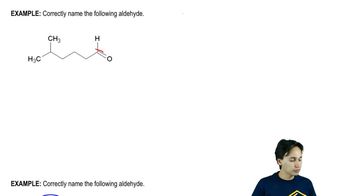
Name the aldehyde
Cross-Linking in Proteins
Cross-linking refers to the formation of covalent bonds between different protein chains, which enhances the stability and mechanical properties of the protein structure. In collagen, cross-links are crucial for its tensile strength and resilience. The formation of these links often involves reactive side chains of amino acids, such as lysine or proline, which can interact with reactive groups like aldehydes, leading to a network of interconnected fibers.
Video consigliato:
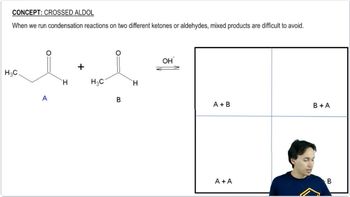
Crossed Aldol
Mechanism of Aldehyde Reactions
The mechanism of aldehyde reactions typically involves nucleophilic attack on the carbonyl carbon, followed by the formation of a tetrahedral intermediate. In weakly acidic conditions, the protonation of the carbonyl oxygen can enhance the electrophilicity of the carbonyl carbon, facilitating the reaction with nucleophiles. This mechanism is essential for understanding how the side chains of amino acids in collagen can react with α,β-unsaturated aldehydes to form cross-links.
Video consigliato:
Name the aldehyde
Pratica correlata
Domanda del libro di testo
987
views
Domanda del libro di testo
Show reaction sequences (not detailed mechanisms) that explain these transformations:
(a)
745
views
Domanda del libro di testo
Propose a mechanism for the following reaction.
661
views
Domanda del libro di testo
Show reaction sequences (not detailed mechanisms) that explain these transformations:
(b)
1093
views
Domanda del libro di testo
(A true story.) Chemistry lab students added an excess of ethylmagnesium bromide to methyl furoate, expecting the Grignard reagent to add twice and form the tertiary alcohol. After water workup, they found that the product was a mixture of two compounds. One was the expected product having two ethyl groups, but the unexpected product had added three ethyl groups. Propose a mechanism to explain the formation of the unexpected product.
725
views