Ch. 22 - Condensations and Alpha Substitutions of Carbonyl Compounds
Wade - Organic Chemistry 9th Edition
Wade9th EditionOrganic ChemistryISBN: 9780135213728Non è quello che usi tu?Cambia libro di testo
Capitolo 22, Problema 35

Esters with only one α hydrogen generally give poor yields in the Claisen condensation. Propose a mechanism for the Claisen condensation of ethyl isobutyrate, and explain why a poor yield is obtained.

Guida verificata passo dopo passo
1
Step 1: Begin by understanding the Claisen condensation mechanism. The Claisen condensation involves the reaction of two ester molecules in the presence of a strong base, typically an alkoxide, to form a β-keto ester. The reaction requires at least one α-hydrogen on the ester to proceed effectively.
Step 2: Analyze the structure of ethyl isobutyrate. Ethyl isobutyrate has only one α-hydrogen attached to the carbon adjacent to the ester group. This α-hydrogen is necessary for enolate ion formation, which is the key intermediate in the Claisen condensation.
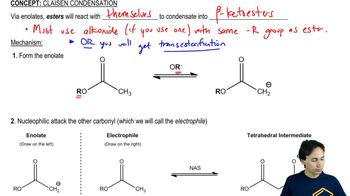
Step 3: Describe the enolate formation step. The base abstracts the α-hydrogen from ethyl isobutyrate, forming an enolate ion. The enolate ion is resonance-stabilized, with the negative charge delocalized between the oxygen atom of the ester group and the α-carbon. Represent this step using the formula: CH3CH2CO2Et→CH2CH2CO2Et-
Step 4: Explain the nucleophilic attack step. The enolate ion attacks another molecule of ethyl isobutyrate at the carbonyl carbon, forming a tetrahedral intermediate. This intermediate then collapses, expelling the alkoxide group and forming the β-keto ester product.
Step 5: Discuss why the yield is poor. Ethyl isobutyrate has only one α-hydrogen, which limits the formation of enolate ions. Additionally, steric hindrance from the isobutyrate group reduces the efficiency of the nucleophilic attack. These factors contribute to the poor yield in the Claisen condensation of ethyl isobutyrate.

Risposta video verificata per un problema simile:

Questa soluzione video è stata consigliata dai nostri tutor come utile per risolvere questo problema.
Durata del video:
5m

Concetti chiave

Ecco i concetti essenziali che devi comprendere per rispondere correttamente alla domanda.

Claisen Condensation

Claisen condensation is a reaction between two esters or an ester and a carbonyl compound in the presence of a strong base, leading to the formation of a β-keto ester or a β-diketone. The mechanism involves the deprotonation of an α-hydrogen by the base, generating an enolate ion that attacks the carbonyl carbon of another ester, resulting in the formation of a new carbon-carbon bond.
Video consigliato:
08:28
Claisen Condensation

α Hydrogen

α hydrogens are the hydrogen atoms attached to the carbon atom adjacent to a carbonyl group. Their presence is crucial in reactions like the Claisen condensation, as they can be deprotonated to form enolate ions. Esters with fewer α hydrogens, such as those with bulky or branched groups, are less likely to form enolates, leading to lower reactivity and poor yields in the condensation reaction.
Video consigliato:
00:48
The definition of hydrogenation.

Steric Hindrance

Steric hindrance refers to the repulsion between bulky groups in a molecule that can impede reactions. In the case of ethyl isobutyrate, the presence of a bulky isobutyl group can hinder the approach of the base to the α hydrogen, making it more difficult to form the enolate. This steric effect contributes to the poor yield observed in the Claisen condensation of esters with limited α hydrogens.
Video consigliato:
02:53
Understanding steric effects.