Ch. 22 - Condensations and Alpha Substitutions of Carbonyl Compounds
Wade - Organic Chemistry 9th Edition
Wade9th EditionOrganic ChemistryISBN: 9780135213728Non è quello che usi tu?Cambia libro di testo
Capitolo 22, Problema 80a

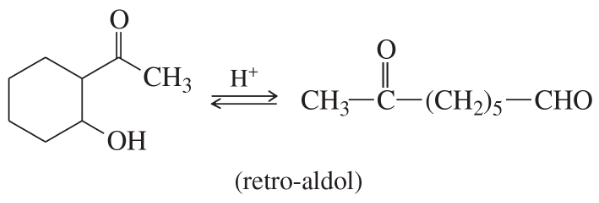
Many of the condensations we have studied are reversible. The reverse reactions are often given the prefix retro-, the Latin word meaning “backward.” Propose mechanisms to account for the following reactions.
(a)

Guida verificata passo dopo passo
1
Step 1: Recognize that the reaction is a retro-aldol reaction, which involves the cleavage of a β-hydroxy ketone or aldehyde into two smaller carbonyl compounds under acidic or basic conditions.
Step 2: Protonate the hydroxyl group (-OH) of the β-hydroxy ketone using the acidic conditions (H+). This makes the hydroxyl group a better leaving group.
Step 3: Form a carbocation by eliminating water (H2O) from the protonated hydroxyl group. This generates a resonance-stabilized intermediate.
Step 4: Break the C-C bond between the α-carbon and β-carbon, resulting in the formation of two carbonyl compounds: one ketone and one aldehyde.
Step 5: Ensure the products are correctly identified as CH3C(O)(CH2)5CHO (aldehyde) and CH3C(O) (ketone), consistent with the reverse of the aldol condensation reaction.

Risposta video verificata per un problema simile:

Questa soluzione video è stata consigliata dai nostri tutor come utile per risolvere questo problema.
Durata del video:
3m

Concetti chiave

Ecco i concetti essenziali che devi comprendere per rispondere correttamente alla domanda.

Retro-Aldol Reaction

The retro-aldol reaction is the reverse of the aldol condensation, where a β-hydroxy carbonyl compound breaks down into two carbonyl compounds. This reaction typically occurs under acidic or basic conditions and is characterized by the cleavage of the carbon-carbon bond formed during the aldol reaction. Understanding this mechanism is crucial for predicting the products of the reaction shown in the question.
Video consigliato:
09:51
Crossed Aldol

Aldol Condensation

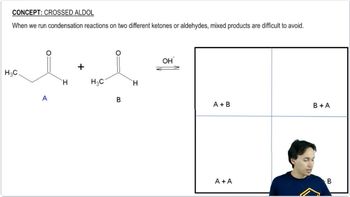
Aldol condensation is a reaction between aldehydes or ketones that contain at least one α-hydrogen, leading to the formation of β-hydroxy carbonyl compounds. This process involves the nucleophilic addition of an enolate ion to a carbonyl carbon, followed by dehydration to yield an α,β-unsaturated carbonyl compound. Recognizing the aldol condensation mechanism helps in understanding how the retro-aldol reaction can occur.
Video consigliato:
09:51
Crossed Aldol

Acid-Base Catalysis

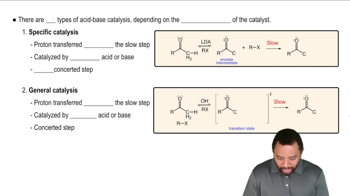
Acid-base catalysis involves the use of acids or bases to accelerate chemical reactions. In the context of retro-aldol reactions, an acid can protonate the hydroxyl group, making it a better leaving group and facilitating the cleavage of the carbon-carbon bond. This concept is essential for understanding how the reaction conditions influence the equilibrium between the aldol and retro-aldol products.
Video consigliato:
Percorso guidato
2:50
Acid-Base Catalysis Concept 3
Pratica correlata
Domanda del libro di testo

Many of the condensations we have studied are reversible. The reverse reactions are often given the prefix retro-, the Latin word meaning “backward.” Propose mechanisms to account for the following reactions.

(b)

637
views

Domanda del libro di testo

Many of the condensations we have studied are reversible. The reverse reactions are often given the prefix retro-, the Latin word meaning “backward.” Propose mechanisms to account for the following reactions.

(c)

1134
views
Domanda del libro di testo

Write equations showing the expected products of the following enamine alkylation and acylation reactions. Then give the final products expected after hydrolysis of the iminium salts.

(d) piperidine enamine of cyclopentanone + methyl vinyl ketone

855
views
Domanda del libro di testo

Write equations showing the expected products of the following enamine alkylation and acylation reactions. Then give the final products expected after hydrolysis of the iminium salts.

(c) piperidine enamine of cyclopentanone + methyl iodide

983
views
Domanda del libro di testo

Show how you would accomplish the following multistep conversions. You may use any additional reagents you need.

(a)

1348
views
Domanda del libro di testo

(A true story.) Chemistry lab students added an excess of ethylmagnesium bromide to methyl furoate, expecting the Grignard reagent to add twice and form the tertiary alcohol. After water workup, they found that the product was a mixture of two compounds. One was the expected product having two ethyl groups, but the unexpected product had added three ethyl groups. Propose a mechanism to explain the formation of the unexpected product.

725
views