Ch. 22 - Condensations and Alpha Substitutions of Carbonyl Compounds
Wade - Organic Chemistry 9th Edition
Wade9th EditionOrganic ChemistryISBN: 9780135213728Non è quello che usi tu?Cambia libro di testo
Capitolo 22, Problema 42c,d

Predict the products from crossed Claisen condensation of the following pairs of esters. Indicate which combinations are poor choices for crossed Claisen condensations.
(c) Chemical reaction diagram showing crossed Claisen condensation between two esters with product formation indicated.
(d) Chemical reaction diagram showing crossed Claisen condensation of two esters with product prediction arrow.

Guida verificata passo dopo passo
1
Identify the esters involved in the crossed Claisen condensation. In a crossed Claisen condensation, two different esters react in the presence of a strong base to form a β-keto ester.
Determine the enolate ion that will form from each ester. The enolate ion is generated from the ester with the more acidic alpha hydrogen. Use the base to deprotonate the alpha hydrogen of the ester to form the enolate ion.
Consider the reactivity of each ester. Esters with no alpha hydrogens cannot form enolates and will act as electrophiles. Identify which ester will act as the nucleophile (enolate) and which will act as the electrophile.
Predict the product by combining the enolate ion with the carbonyl carbon of the electrophilic ester. This forms a new carbon-carbon bond, resulting in a β-keto ester.
Evaluate the choice of esters for the reaction. A poor choice for crossed Claisen condensation occurs when both esters can form enolates, leading to a mixture of products. Ideally, one ester should lack alpha hydrogens to avoid multiple products.

Risposta video verificata per un problema simile:

Questa soluzione video è stata consigliata dai nostri tutor come utile per risolvere questo problema.
Durata del video:
2m

Concetti chiave

Ecco i concetti essenziali che devi comprendere per rispondere correttamente alla domanda.

Claisen Condensation

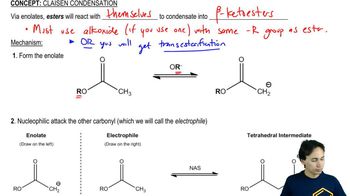
Claisen condensation is a reaction between two esters or an ester and a carbonyl compound in the presence of a strong base, leading to the formation of a β-keto ester or a β-diketone. This reaction involves the nucleophilic attack of an enolate ion derived from one ester on the carbonyl carbon of another ester, followed by the elimination of an alcohol. Understanding this mechanism is crucial for predicting the products of crossed Claisen condensations.
Video consigliato:
08:28
Claisen Condensation

Enolate Ion Formation

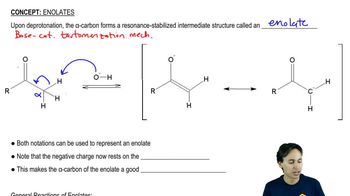
Enolate ions are formed when a strong base abstracts a proton from the α-carbon of an ester, resulting in a resonance-stabilized anion. The stability of the enolate ion is influenced by the substituents on the ester, which can affect the reactivity in the Claisen condensation. Recognizing how to generate and utilize enolate ions is essential for successfully predicting the outcomes of crossed Claisen reactions.
Video consigliato:
02:26
Formation of Enolates

Crossed Claisen Condensation Limitations

Crossed Claisen condensation can lead to multiple products, especially when using two different esters. Poor choices for this reaction typically involve esters that can both form enolates, leading to self-condensation rather than the desired crossed product. Identifying which ester combinations are likely to yield unwanted products is key to successfully predicting the outcomes of these reactions.
Video consigliato:
08:28
Claisen Condensation